
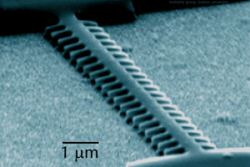
The realm of quantum mechanics met the world of classical physics when an antenna-like sliver of silicon one-tenth the width of a human hair oscillated in a Boston University lab. With two sets of protrusions, much like the teeth from a two-sided comb, the antenna not only exhibits the first quantum nanomechanical motion but is also the world’s fastest moving nanostructure. Comprised of 50 billion atoms, the antenna built is so far the largest structure to display quantum mechanical movements. The device is also the fastest of its kind, oscillating at 1.49 gigahertz, or 1.49 billion times a second. The quantum effect is evident when the nanomechanical oscillator starts to jump between two discrete positions without occupying the physical space in between.
Physicists led by Pritiraj Mohanty developed the nanomechanical oscillator at Boston University. Operating at gigahertz speeds, it could help further miniaturize wireless communication devices, but more important to the researchers, the oscillator lies at the cusp of traditional physics and quantum physics. “It’s a truly macroscopic quantum system,” says Alexei Gaidarzhy, the paper’s lead author.
When fabricating and testing the nanomechanical device, the researchers placed the entire apparatus, including the cryostat and monitoring devices, in a copper-walled, copper-floored room. This set-up shielded the experiment from unwanted vibration noise and electromagnetic radiation that could generate from outside electrical devices, such as cell phone signals, or even the movement of subway trains outside the building. Even with these precautions, performing such novel experiments is tricky. “When it’s a new phenomenon, it’s best not to be guided by expectations based on conventional wisdom,” says Gaidarzhy. “The philosophy here is to let the data speak for itself.” The group carries out the experiments under extremely cold conditions, at a temperature of 110 millikelvin, which is only a tenth of a degree above the absolute zero. When cooled to such a low temperature, the nanomechanical oscillator starts to jump between two discrete positions without occupying the physical space in between, a telltale sign of quantum behavior.
(Pic courtesy Boston University)
Related posts:
 Quantum tricks turbocharge magnetic storage
 Are we living in a computer simulation? Physicists propose test to find out
 First demonstration of coherent control of a quantum multi-resonator architecture
 Casimir Force Gets Hot And Sticky
 The Strange Case Of The Missing Dimension
 Quantum Computer Computes, While Not Operating











Comments are closed.