

Physicists at JILA (a joint initiative of the National Institute of Standards and Technology (NIST) and the University of Colorado at Boulder) have shown that when a surface is warmed, the Casimir-Polder force it exerts becomes stronger.
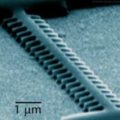
The Casimir-Polder force, one of the stranger effects of quantum mechanics, arises from the ever-present random fluctuation of microscopic electric fields in empty space. The fluctuations get stronger near a surface, and an isolated neutral atom nearby will feel them as a subtle pull – much like gravitation. Understanding the Casimir force is of great importance to nanotechnology researchers as it influences the design of devices that rely on small-scale interactions, such as atom chips, nanomachines, and microelectromechanical systems.
Writing in Physical Review Letters, the JILA team describe the first measurement of the temperature dependence of this force. By using a combination of temperatures at opposite extremes – making a glass surface very hot while keeping the environment neutral and using ultracold atoms as a measurement tool – the new research underscores the power of surfaces to influence the Casimir-Polder force. That is, electric fields within the glass mostly reflect inside the surface but also leak out a little bit to greatly strengthen the fluctuations in neighboring space. As a result, says JILA researcher Eric Cornell, “warm glass is stickier than cold glass.”
In the JILA experiments, a BEC of about 250,000 rubidium atoms in a magnetic trap was placed a few micrometers from a glass plate. As the BEC was brought closer to the surface, the “wiggling” of the condensate was observed over time and the changes in the oscillation frequency allowed the researchers to calculate the force. The measurements were made as a laser beam was used to heat the glass plate to about 330 degrees Celsius, while the surrounding environment was kept near room temperature. The strength of the force was shown to be nearly three times larger when the glass was heated.
Related articles:
“Holy Grail” of Universe Still a Mystery
Scientists Hope To Reveal “Extra Dimensions,” Exotic Forces
Less Than Zero-Point Energy












Comments are closed.