
When you nod your head to show approval or shake your head to show disapproval, it’s not just sending a message to others – you may also be influencing yourself.
A recent study has shown that these simple movements influenced people’s agreement with an editorial they heard while nodding or shaking their head. Researchers found that other body movements – such as writing with a non-dominant hand – can also influence attitudes, even about important issues such as self-esteem.
And these body movements exert their influence without people being aware of what is happening.
“We think of nodding or shaking our head as something that communicates to other people, but it turns out that it is also communicating to ourselves,” said Richard Petty, co-author of the study and professor of psychology at Ohio State University.
In a sense, Petty said, nodding or shaking your head, as well as other body movements, serve as a kind of “self-validation” that confirms to us how we feel about our own thoughts.
“If we are nodding our heads up and down, we gain confidence in what we are thinking. But when we shake our heads from side to side, we lose confidence in our own thoughts.”
Petty conducted the study with Pablo Brinol, from the Universidad Autonoma de Madrid in Spain. The research appears in the current issue of the Journal of Personality and Social Psychology.
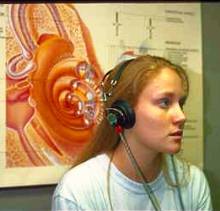
In one study, the researchers told 82 college students that they were testing the sound quality of stereo headphones – particularly how the headphones would perform when they are being jostled, as during dancing or jogging.
Half the participants were told to move their heads up and down (nodding) about once per second while wearing the headphones. The other half was told to move their heads from side to side (shaking) while listening on the headphones.
All of the participants listened to a tape of a purported campus radio program that included music and a station editorial advocating that students be required to carry personal identification cards.
The study found that head movements did affect whether they agreed with the editorial. But the effect is more complicated than might be expected.
The study found that nodding your head up and down is, in effect, telling yourself that you have confidence in your own thoughts – whether those thoughts are positive or negative. Shaking your head does the opposite: it gives people less confidence in their own thoughts.
So participants in this study who heard an editorial that made good arguments agreed more with the message when they were nodding in a “yes” manner than shaking in a “no” manner. This is because the nodding movements increased confidence in the favorable thoughts people had to the good arguments compared to shaking.
However, students who heard an editorial that made poor arguments showed the reverse pattern. These students agreed less with the message when they were nodding than when shaking. This is because the nodding movements increased confidence in the negative thoughts they had to the poor arguments compared to shaking.
“Nodding your head doesn’t mean you’ll agree with whatever you hear. One of the most surprising things we found is that if you’re thinking negative thoughts while you’re nodding, this actually strengthens your disapproval,” Petty said. “What the head nodding is doing is making you more confident in your negative thoughts. In contrast, when the thoughts were mostly positive, then nodding increased confidence in these thoughts and thereby increased persuasion.”
Another study found the same results occurred even when participants were evaluating something they knew very well: themselves. And it occurred with a completely different kind of body motion: handwriting.
In this case, the participants were asked to write down three good or bad qualities they thought they had with respect to their planned careers. But some were told to write with their right hand, while others were told to write with their left hand (all were determined to be right-handed). They were then asked to rate how confident they were in the thoughts they had listed.
Results showed that the participants had more confidence in their thoughts when they wrote them with their right (dominant) hand than when they wrote with the left (non-dominant) hand.
“As with the head nodding, using the dominant hand affected how confident participants were in their own thoughts,” Petty said.
In all the studies, the participants were questioned afterwards to determine if they suspected their head movements or writing with a non-dominant hand influenced their attitudes. None thought so.
Petty said a whole range of body movements, including things such as smiling, as well as other factors such as mood, influence our attitudes to an extent we are unaware.
“We like to think of ourselves as totally rational,” Petty said. “We like to think that if we’re confident in something, it is because we’ve investigated the issues thoroughly. We certainly don’t want to believe that our confidence can come because we’re smiling, or nodding, or because we’re in a good mood. But that seems to be the case.”
Petty said it is significant that these body movements can even affect confidence in thoughts about issues in our lives that are important to us and that we have thought about deeply – like our own self-evaluations.
“The fact that this impacts us on our most important decisions and when we are being very thoughtful, that makes this dangerous in some sense,” he said. “We have to be very vigilant when we’re evaluating our own thoughts. We need to think about why we are confident or not confident in certain attitudes.”
Related posts:
 Could our beliefs about human consciousness and the notion of self be completely wrong?
 New research suggests smartphone use associated with lowered intelligence
 Biological basis for magic mushrooms’ mind-expansion revealed
 Could “free will” arise from random brain noise?
 Incense Found To Be Psychoactive
 High Quality Meteor Spectrum Caught By Chance











Comments are closed.