
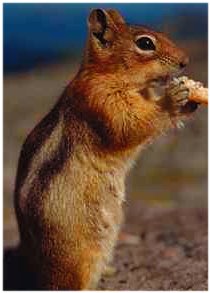
For the first time ever, a University of Alberta researcher has discovered that an animal species has changed its genetic make-up to cope with global warming. In the past, organisms have shown the flexibility – or plasticity – to adapt to their surroundings, but this is the first time it has been proven a species has responded genetically to cope with environmental forces.
Dr. Stan Boutin, from the Department of Biological Sciences at the University of Alberta in Edmonton, has been studying a North American red squirrel population in Canada’s southwest Yukon for almost 15 years. The squirrels, faced with increasing spring temperatures and food supply, have advanced the timing of breeding by 18 days over the last 10 years-six days for each generation. His findings appear on First Cite and will appear in the journal Proceedings of the Royal Society London B next month.
Phenotypic plasticity is measured by how an individual squirrel can change the timing of a reproductive cycle from one year to the next compared to one generation to the next, which is what Boutin is studying. “Only by having long-term lineages can we get at this research,” he said.
Although this discovery shows the red squirrel is adapting well to its warmer environment, the future is still a concern to scientists especially considering the rapid rate of climate change. Predicting the squirrel’s threshold is also impossible, said Boutin, so it is difficult to know if the animal has reached is peak of “adaptation skills.” The next step is to look at different components of the genome to see if researchers can pinpoint more closely the set of genes responsible for these changes.
Related posts:
 Tylenol and other paracetamol painkillers may hinder the brain’s error-correction mechanisms
 Placebo response growing over time – but only in America
 Rats Showing Some Backbone After Stem Cell Treatment
 Super Strong Artificial Muscles Could Power Next Generation Of Robots
 MOF Power
 Quantum Computer Computes, While Not Operating








Comments are closed.