
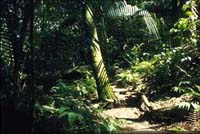
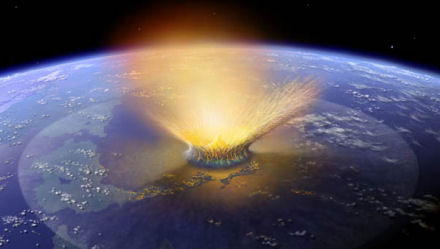
NASA scientists will venture into an isolated part of the Bolivian Amazon to try and uncover the origin of a 5 mile (8 kilometer) diameter crater there known as the Iturralde Crater. Traveling to this inhospitable forest setting, the Iturralde Crater Expedition 2002 will seek to determine if the unusual circular crater was created by a meteor or comet. Organized by Dr. Peter Wasilewski of NASA’s Goddard Space Flight Center, Greenbelt, Md., the Iturralde Crater Expedition 2002 will be led by Dr. Tim Killeen of Conservation International, which is based in Bolivia. Killeen will be assisted by Dr. Compton Tucker of Goddard.
The team intends to collect and analyze rocks and soil, look for glass particles that develop from meteor impacts and study magnetic properties in the area to determine if the Iturralde site, discovered in the mid-1980s with satellite imagery, was indeed created by a meteor.
If a meteorite is responsible for the impression, rocks in the area will have shock features that do not develop under normal geological circumstances. The team will also look for glass particles, which develop from the high temperatures of impact.
The large crater is only 1 meter lower in elevation than the surrounding area. Water collects within the depression, but not on the rim of the crater, which is slightly higher than both the surrounding landscape and the interior of the crater. These subtle differences in drainage are reflected in the forest and grassland habitats that developed on the landscape. It is precisely these differences in the vegetation structure that can be observed from space and which led to the identification of the Iturralde Crater in the 1970s when Landsat Images first became available for Bolivia.
Impact craters can also be confirmed through the magnetic study of the impact zone. Dr. Wasilewski’s team will conduct ground magnetometer surveys and will examine the area through an unmanned aerial vehicle plane fitted with a magnetometer, an instrument for measuring the magnitude and direction of magnetic field. The resulting data will be analyzed by associating the magnetic readings with geographical coordinates, to map magnetic properties of the area. The magnetometer data could provide conclusive evidence as to whether or not the Iturralde feature is an impact crater.
The Iturralde Crater Expedition 2002 expedition also contains an education component. Teachers from around the world who are involved with the teacher professional development program, called Teacher as Scientist, have helped to design the expedition. One teacher will actually be on-site assisting with data collection.
University students from Bolivia will also be involved in the expedition. The educational element of the expedition is just as important as the science results,” said Goddard engineer Patrick Coronado. “This is one of those experiments that stirs the imagination, where science and technology come head-to-head with nature in an attempt to unlock its secrets.”




Comments are closed.