
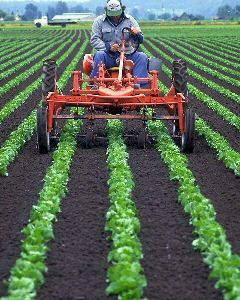
Agriculture is rapidly approaching a time of massive change, says an article in Agronomy Journal. Impacted by the end of cheap energy, depleted water resources, impaired ecosystem services and unstable climates, agricultural industries will have to find new ways to feed a world whose appetite for food crops will grow by around 75 percent over the next 50 years. Article author, Fred Kirschenmann, of Iowa State University, believes that biodiverse farming may provide the answers.
Biodiverse farming exploits the biological synergies inherent in multi-species systems; a methodology far removed from today’s monocultural, energy intensive industrial agriculture systems that are based on specialization, simplification, therapeutic intervention and cheap energy.
Likewise, Joel Salatin, of Polyface Farms near Swoope, VA, has developed a rotational grazing production system featuring pastures containing at least 40 varieties of plants and numerous animal species. Salatin’s farm uses little fossil fuel, yet the farm is highly productive. The 57-hectare farm annually produces 30,000 dozen eggs, 10,000 to 12,000 broilers, 100 beef animals, 250 hogs, 800 turkeys and 600 rabbits.
Kirschenmann believes that climate change will play a big role in determining the farming methods of the future. Volatile weather conditions will make it difficult to sustain highly specialized monoculture cropping systems which require relatively stable climates. Farmers likely will need to adjust quickly, he says, adopting methods that are more resilient in the face of unstable climates, and that begin to out-produce monocultures by virtue of their multi-species output.
He cites another study which showed that diverse, synergistic farms can be profitable and simultaneously benefit the environment. The study demonstrated that when farms are converted from corn/soybean monocultures to more diverse operations, net farm income can increase by as much as 108 percent, while generating significant environmental and social benefits. The key principles of biodiverse farming, according to Kirschenmann, are:
- Be energy conserving
- Feature both biological and genetic diversity
- Be largely self-regulating and self-renewing
- Be knowledge intensive
- Operate on biological synergies
- Employ adaptive management
- Feature ecological restoration rather than choosing between extraction and preservation
- Achieve optimum productivity by featuring nutrient-density, and multi-product synergistic production on limited acreage
Read the whole article at http://agron.scijournals.org/cgi/content/abstract/99/2/373






Comments are closed.