
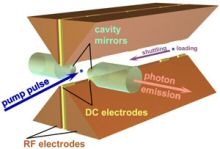
In recent times, new types of light sources have been developed that emit photons one by one. Experiments with such emitters are motivated by plans for quantum computers or quantum information networks that use the quantum states of photons to process and transfer information. To work reliably, these quantum processing schemes require emission and absorption of the photons in a fully controlled way. One method of creating a single photon is to place a single atom between two mirrors, which form a cavity. From an excited state, the atom emits a single photon into the cavity. The main problem is the lack of control over the position of the atom in the cavity due to the limitations of trapping technology. This leads to randomly fluctuating conditions for photon generation and hence random properties inherent in the emitted photons.
Now however, Matthias Keller, Birgit Lange, Kazuhiro Hayasaka, Wolfgang Lange and Herbert Walther of the Max Planck Institute of Quantum Optics believe they have overcome the limitations of trapped atoms in cavities. Their research, published inNature, has important applications in quantum information processing.
The ion was placed between two high-reflectivity mirrors, the distance between the mirrors adjusted so that a standing light wave can form between them when a suitable atomic transition occurs. Energy is supplied by exciting the ion with a laser beam injected from the side of the cavity. When the system parameters are set correctly, the ion absorbs a photon from the external laser. Subsequently, the strong interaction with the cavity mode induces the ion to emit a single photon. After the emission, the ion’s state does not allow it to absorb any further light and the creation of a second photon is not possible. In order to deliver the created photon to the outside world, one of the mirrors is made partially transparent, causing the photon to “leak” out of the cavity, thus completing the process of single-photon generation.
The researchers have extracted a continuous stream of single photons for an unprecedented 90 minutes. This is important for the reliable operation of the device in quantum information processing.
Image Courtesy of the Max Planck Institute for Quantum Optics
Related posts:
 Physicists map conductivity change in transition from 3 to 2 dimensions
 Image captures light as both a particle and a wave
 Quantum camera takes pic using only entangled photons
 Researchers go beyond quantum limit
 “Solar steam” generator outshines photovoltaic solar cells
 Gonorrhea set to attain superbug status











Comments are closed.