Home   |   News   |   Discussion Forum   |   Books   |   Curiosity Shop
Discussion Forum
Recent Posts
BioFuel Crops are a Crime
Rallem
Today at 08:02 AM
Human Influence on Climate
John M Reynolds
Today at 04:40 AM
Most Influential Sci Fi Movie
Mike Kremer
Yesterday at 05:36 PM
The Big Crunch will happen after an infinite time
odin1
Yesterday at 12:38 PM
Type I civilization: can we make it?
big fat pig
Yesterday at 12:18 PM
Aether Wave Theory
Zephir
Yesterday at 10:40 AM
D.O.E. 30 billion loan guarantee program
paul
07/03/08 06:14 PM
Bush BLM flip flops back to sanity
paul
07/03/08 04:56 PM
Universe'sExpansion Non-uniform?
Mike Kremer
07/03/08 04:22 PM
Philosophy of Religions--all religions, including,
Revlgking
07/02/08 01:06 PM
Hot Topics

The Environment

Evolution

Space

Mind/Brain

Electronics

Climate Change


Search
Custom Search
Sponsored Links
Most Read
Hormones Gone Wild
Homo Superior
The Universe As Magic Roundabout
In Space, No One Can Hear You Say "Doh!"
Bow To Your Insect Overlords!
Bionics
Sex And The Schizoid Factor
Delusions And Mental Illness
We Come In Peace – NOT!
Eeew!
Small Penis Syndrome A Big Problem?
Have You Hugged Your Robot Today?
Down On The Farm - Yields, Nutrients And Soil Quality
Cat Parasite Has Global Ambitions
POP Goes The Planet
The Disappearing Male
Missing Link A Tripping Chimp?
Inorganic Dust Formations Alive?
Science Shopping
Sci Shop
Peculiar scientific stuff that you didn't even know existed and you don't need.
News And Research

Physics

Climate Change

Space

Natural World

Health

Technology


All 2008 News

Rusty's Reading List
Sci Books
Join Rusty Rockets for the lowdown on what you should be reading.
Archives
2008 2007
2006 2005 2004
2003 2002 2001
2000 1999 1998
Discussions
Features


6 November 2000
Bipedal Reptile Fossil Predates Dinosaurs
by Kate Melville

The oldest known fossil of an upright, bipedal reptile, which predates the age of the dinosaurs by at least 60 million years, has been discovered by an international team of scientists including two University of Toronto paleontologists.

"There are only a couple of times in evolutionary history when animals have gone from a sprawled posture like that of a four-legged lizard to an upright posture when they tuck their limbs under the body," explains U of T at Mississauga paleontology professor Robert Reisz, one of the lead authors of a paper to be published in the Nov. 3 edition of Science. "It happened once in dinosaurs and again with mammals. So to find an example of an animal that did this before dinosaurs or mammals is particularly exciting."

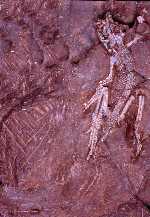
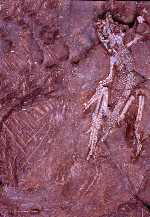
The 290-million-year-old specimen, which looks something like an upright lizard with forearms and a tail that more than doubles its body length, lived during the Permian period between 295 and 250 million years ago. Found in Germany in 1993, it is approximately 25 to 30 cm long and is preserved as a complete skeleton on a single slab of rock.

According to Reisz, this animal - formally known as Eudibamus cursoris - is a bolosaurid. This group of small reptiles died out near the end of the Permian period, which is marked by the largest extinction of life in the history of the Earth and is commonly recognized as the age before the dinosaurs.

"The bolosaurs proved to be a very interesting evolutionary experiment," Reisz says. "It was thought that the ability to run on two legs and stand upright first emerged in dinosaurs and their relatives. But this discovery has shown interesting and exciting things happening in the evolutionary history of reptiles well before the advent of dinosaurs. Other work, some of it still in progress, supports this idea, and we now have strong evidence of the early evolution of herbivorous reptiles on land."

This small reptile was also a herbivore and the researchers interpret its upright, bipedal ability as a mechanism for escaping predators, not becoming one as in the case of dinosaurs. "Since this bolosaur was able to tuck in its limbs under the body and run on two legs, it was basically faster than anything else around at the time. And for a small herbivorous animal that makes a lot of sense, especially when there are lots of larger predators around," Reisz adds.

Fragments of other bolosaurs have been found in what is now North America, China and Russia, confirming the widespread early distribution of this reptile. What makes this find even more significant is that most of the reptiles that lived during the early Permian were characterized by massive girdles, short, stocky limbs, a sprawling posture and gait, and relatively slow locomotion.




Home   |   News   |   Discussion Forum   |   Books   |   Curiosity Shop   |   About
The terms and conditions governing your use of this website.
Copyright © 1997 - 2008 Science a Go Go and its licensors. All rights reserved.