
Home   |   News   |   Discussion Forum   |   Books   |   Curiosity Shop
Discussion Forum
Recent Posts
100,000 Gorillas Discovered
Rallem
10:22 AM
Semantics, Etymology, Syntactics, Etc.
Zephir
04:32 AM
NASA Tastes Martian Water
Mike Kremer
05:07 PM
Philosophy of religion: Yours, MIne and Ours...
Revlgking
09:29 AM
Your view please: solar torrefaction of biomass
Louise
08/06/08 04:31 AM
About the philosophy of the negation of the axiom
Zephir
08/06/08 03:10 AM
Vitamin C Jabs Fight Cancer
Mike Kremer
08/05/08 07:58 PM
Philosophy of Religions--all religions, including,
Revlgking
08/05/08 05:59 PM
Worlds Oldest Calculator
Rallem
08/05/08 02:37 PM
Aether Wave Theory
Zephir
08/05/08 11:23 AM
Hot Topics

The Environment

Evolution

Space

Mind/Brain

Electronics

Climate Change


Search
Custom Search
Sponsored Links
Most Read
Hormones Gone Wild
Homo Superior
The Universe As Magic Roundabout
In Space, No One Can Hear You Say "Doh!"
Bow To Your Insect Overlords!
Bionics
Sex And The Schizoid Factor
Delusions And Mental Illness
We Come In Peace – NOT!
Eeew!
Small Penis Syndrome A Big Problem?
Have You Hugged Your Robot Today?
Down On The Farm - Yields, Nutrients And Soil Quality
Cat Parasite Has Global Ambitions
POP Goes The Planet
The Disappearing Male
Missing Link A Tripping Chimp?
Inorganic Dust Formations Alive?
Science Shopping
Sci Shop
Peculiar scientific stuff that you didn't even know existed and you don't need.
News And Research

Physics

Climate Change

Space

Natural World

Health

Technology


All 2008 News

Rusty's Reading List
Sci Books
Join Rusty Rockets for the lowdown on what you should be reading.
Archives
2008 2007
2006 2005 2004
2003 2002 2001
2000 1999 1998
Discussions
Features


8 February 2008
GM Cotton Gets First Resistant Pest
by Kate Melville

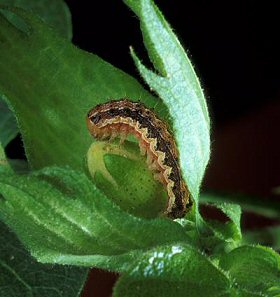
Bollworm are the first pests to evolve resistance in the field to cotton plants modified to produce an insecticide called Bt, according to a new research report in Nature Biotechnology. Bt-resistant populations of bollworm, Helicoverpa zea, were found in more than a dozen crop fields in Mississippi and Arkansas between 2003 and 2006. "What we're seeing is evolution in action," said lead researcher Bruce Tabashnik. "This is the first documented case of field-evolved resistance to a Bt crop."

Bt crops are so named because they have been genetically altered to produce Bt toxins, which kill some insects. The data documenting bollworm resistance were first collected seven years after Bt cotton was introduced in 1996.

The researchers write in their report that Bt cotton and Bt corn have been grown on more than 400 million acres worldwide since 1996, "generating one of the largest selections for insect resistance ever known." Even so, the researchers found that most caterpillar pests of cotton and corn remained susceptible to Bt crops. "The resistance occurred in one particular pest in one part of the U.S.," Tabashnik said. "The other major pests attacking Bt crops have not evolved resistance. And even most bollworm populations have not evolved resistance."

The field outcomes refute some experts' worst-case scenarios that predicted pests would become resistant to Bt crops in as few as three years, he said. "The only other case of field-evolved resistance to Bt toxins involves resistance to Bt sprays," Tabashnik said. He added that such sprays have been used for decades, but now represent a small proportion of the Bt used against crop pests.

To delay resistance, non-Bt crops are planted near Bt crops to provide "refuges" for susceptible pests. Because resistant insects are rare, the only mates they are likely to encounter would be susceptible insects from the refuges. The hybrid offspring of such a mating generally would be susceptible to the toxin. In most pests, offspring are resistant to Bt toxins only if both parents are resistant.

In bollworm, however, hybrid offspring produced by matings between susceptible and resistant moths are resistant. Such a dominant inheritance of resistance was predicted to make resistance evolve faster. The UA researchers found that bollworm resistance evolved fastest in the states with the lowest abundance of refuges. The field outcomes documented by the global monitoring data fit the predictions of the theory underlying the refuge strategy, Tabashnik said.

Related:
Yes, We Have No Bananas
Biodiversity - Key To Ecosystem Health
Down On The Farm? Yields, Nutrients And Soil Quality

Source: University of Arizona



Home   |   News   |   Discussion Forum   |   Books   |   Curiosity Shop   |   About
The terms and conditions governing your use of this website.
Copyright © 1997 - 2008 Science a Go Go and its licensors. All rights reserved.