

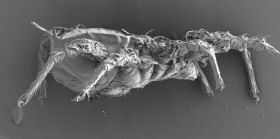
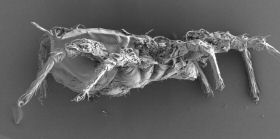
Researchers from the University of Darmstadt in Germany and the SUNY College of Environmental Science and Forestry reported this week on a family of mites that have forsaken asexual reproduction and re-evolved to reproduce sexually. Reported in theProceedings of the National Academy of Sciences, the revival of a complex trait such as sexual reproduction after it had been dormant for millions of years raises interesting questions about our understanding of evolutionary biology.
Mainly found in soils in the southern hemisphere, oribatid mites (or beetle mites) perform a vital role as decomposition agents, grazing on fungi, decaying leaves and other organic matter. The critters are also found on trees and rocks and Norton speculates that moving from their ancestral home in the ground, where organic material is plentiful, to trees and rocks, where food can be scarce, could account for the change in reproduction. “The increased exposure and competition for food may create a need for more responsive genetic defense mechanisms,” he said.
The discovery raises some intriguing questions. Why do some organisms continue to reproduce asexually, given the distinct evolutionary advantages – especially defenses against parasites, predators and competitors – from reproducing sexually and mixing genomes? And how can an organism jump-start a group of genes – such as those specific to sexual reproduction – after many millions of years of not being used?
Related articles:
Sex Optional For Evolutionary Adaptation
Horizontal Gene Transfer Accelerating Evolution
Lizards Pushed Into Evolutionary Fast Lane
Asexual Reproduction The First Step To Extinction
Source: SUNY College of Environmental Science and Forestry


![Larry's Skill Holofoil [PRE - 139/131] picture](/store/img/g/SHQAAeSwM-Nqr1SS/s-l225/Larry-s-Skill-Holofoil-PRE-139-131-.jpg)