

Home   |   News    |   Discussions   |   Books   |   Curiosities
Search
Custom Search
Popular Reads

Earthquakes and animal behavior
LHC may produce time travelling particles
Country boys boast bigger junk
Running the numbers on alien life
Uh-oh, placebo
Forgetful? Blame your house
Pill to blame for rise in prostate cancer?
Cat parasite has global ambitions
Carbon monoxide keeps city dwellers happy
Magnetic field alters moral judgments
Stars manufacturing organic matter?
Unnatural selection: Courtesy of The Pill
Men 2% funnier than women
Parasite rewires sexual attraction
Novel psychiatric drugs take aim at gut bacteria
Discussions
General Science

Not-Quite Science

Physics

Climate Change

Science Fiction

Past Forums

Sponsored Links
Browse

Animal Kingdom

Biology

Climate Change

Environment

Evolution

Genetics

Humans

Mind & Brain

Prehistory

Health & Diet

Health Threats

Health & Environment

Health: From The Lab

Mental Health

Reproductive Health

Energy Alternatives

Chemistry

Computing & Electronics

Nanotechnology

Pimping Nature

Robotics & AI

Physics

Space


Curiosities
Sci Shop
Peculiar and bizarre scientific stuff that you didn't even know existed and you don't need.
Books
Book Reviews
Rusty Rockets lists his all-time favorite science titles.
Archives
2012 2011 2010
2009 2008 2007
2006 2005 2004
2003 2002 2001
2000 1999 1998
Feature Archive


20 August 2009
Decomposing plastic refuse releasing BPA into oceans
by Kate Melville

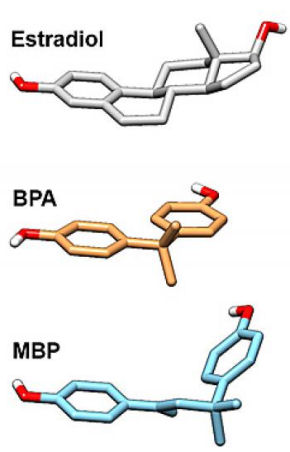
Plastic waste in the ocean isn't just unsightly and a danger to marine animals. Scientists have now found that certain plastics breakdown rapidly in the ocean, releasing a heady cocktail of toxic chemicals such as bisphenol A (BPA) which is known to interfere with mammalian reproductive systems.

In the first study to look at how plastic waste breaks-down in seawater, scientists from Nihon University in Japan report that many plastics decompose in the ocean with surprising speed. They delivered their findings to the 238th National Meeting of the American Chemical Society (ACS), where they called the discovery "surprising."

"Plastics in daily use are generally assumed to be quite stable," said lead researcher Katsuhiko Saido. "We found that plastic in the ocean actually decomposes as it is exposed to the rain and sun and other environmental conditions, giving rise to yet another source of global contamination that will continue into the future."

Saido said his team found that when plastic decomposes it releases potentially toxic BPA and PS oligomer into the water. Plastics usually do not break down in an animal's body after being eaten. However, the substances released from decomposing plastic are absorbed and could have adverse effects. BPA and PS oligomer are sources of concern because they can disrupt the functioning of hormones in animals and can seriously affect reproductive systems.

Saido also described a new method to simulate the breakdown of plastic products in the ocean. The process involves modeling plastic decomposition at room temperature, removing heat from the plastic and then using a liquid to extract the BPA and PS oligomer. When the plastic broke-down, it released three new compounds not found in nature. They were styrene monomer, styrene dimer and styrene trimer. Styrene monomer is a known carcinogen and the others are suspected in causing cancer.

Related:
BPA found to have "dramatic" effect on adult hormone levels
Experts demand FDA act on BPA report
Fresh concerns about BPA

Source: American Chemical Society


Social

Follow Science a GoGo


Home         All The News      Science Forum         Books, Books, Books         Curiosity Shop         About

The terms and conditions governing your use of this website.
Copyright © 1997 - 2012 Science a Go Go and its licensors. All rights reserved.