

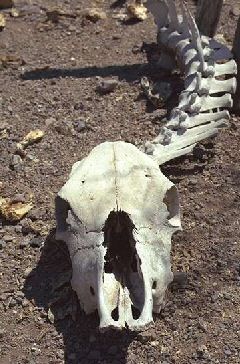
Scientists from Montana State University and Louisiana State University have found evidence that globally distributed airborne bacteria play a pivotal role in the rain cycle. The research, published inScience, will have far reaching implications in fields such as ecology, microbiology, plant pathology and climatology.
The researchers examined precipitation from locations around the world, including California, the eastern U.S., Australia, South Africa, Morocco, France and Russia and found that the most active ice nuclei are actually biological in origin. Nuclei are the seeds around which ice is formed. Most rain begins with the formation of ice in clouds. While dust and soot can also serve as ice nuclei, only biological nuclei can cause freezing at warmer temperatures.
The findings also indicate that a reduced amount of bacteria on crops could affect the climate. Because of the bio-precipitation cycle, overgrazing in a dry year could actually decrease rainfall, which could then make the next year even dryer. “Drought could be less of a problem once we understand all of this,” Sands said.
More studies must be done, though, because questions remain. For example, since the bacteria do not grow above 84 degrees, precipitation could be affected if the world’s weather continues to warm. The researchers are also examining the bacteria to find out if they vary by region.
What makes the bacterial-plant interplay more complicated is that most known ice-nucleating bacteria are actually plant pathogens. These pathogens can cause freezing injury in plants, resulting in devastating economic effects on agricultural crop yields. “Bacteria have probably been around for a million years,” Sands said. “They live on the surface of plants, and may occasionally cause plant disease. But their role in rain-making may be more important.”
Related:
Airborne Nanobacteria Spread Disease, Create Rain
Climatologists Identify Areas To Be Most Affected By Warming
Source: Montana State University








Related posts:
 Significant bacterial populations found in upper atmosphere
 Bacteria make rain, bioprecipitation researchers say
 DNA of bacteria that live in the body passed from mother to child
 New analysis pokes holes in biodiversity’s supposed link to human disease
 Mating choices driven by bacteria?
 Switching Genes On And Off To Cure Disease