Home   |   Sci News   |   Discussion Forum   |   Books, Books, Books   |   Curiosity Shop
Discussion Forums
General Science

Not-Quite Science

Physics

Climate Change

Science Fiction

Past Forums

Search
Custom Search
Sponsored Links
News And Research

Animal Kingdom

Biology

Climate Change

Environment

Evolution

Genetics

Humans

Mind & Brain

Prehistory

Health & Diet

Health Threats

Health & Environment

Health: From The Lab

Mental Health

Reproductive Health

Energy Alternatives

Chemistry

Computing & Electronics

Nanotechnology

Pimping Nature

Robotics & AI

Physics

Space


Science Shopping
Sci Shop
Peculiar and bizarre scientific stuff that you didn't even know existed and you don't need.
Science Books
Book Reviews
Rusty Rockets lists his all-time favorite science titles.
Archives
2010
2009 2008 2007
2006 2005 2004
2003 2002 2001
2000 1999 1998
Feature Archive

Bookmark and Share


1 August 2007
Girth, Not Length, Makes For Healthy Streams
by Kate Melville

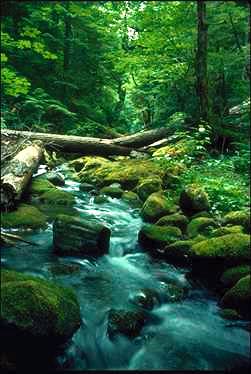
How much excess nitrogen - from fertilizers, animal waste, sewer lines, and highways - reaches waterways appears to be heavily influenced by the width of the vegetated borders around the stream. A new study from the EPA has found that borders of at least 50 meters are required for optimal removal of the human-produced nitrogen byproducts that can contaminate waterways.

The researchers collected data on various buffers along with nitrogen concentration in streams and groundwater to identify trends between nitrogen removal and buffer width, water flow path and vegetation. They found wide buffers (greater than 50 meters) removed more nitrogen than narrow buffers (0-25 meters).

Writing in the Journal of Environmental Quality, the researchers explained that different vegetation types may be an important factor in certain landscapes and hydrologic settings where forested buffers may prevent nitrogen in deep groundwater or contribute more organic carbon in streams. Riparian buffers of herbaceous vegetation or a mix with forest vegetation were found to be effective only when wider.

The study also noted that riparian services provide numerous ecosystem services beyond nitrogen removal, and although buffer width, dimension, and vegetation type provide benefits such as stream shading and water temperature maintenance, fish and wildlife habitat, or sediment control; there may be other buffer characteristics more favorable in removing nitrogen. The researchers caution, however, that watershed nutrient management efforts also must include control and reduction of specific and general sources of nitrogen from atmospheric, land, and water inputs.

Related articles:
Gloomy Prognosis For Amphibians
Road De-Icing Threatens U.S. Aquatic Habitats
Waterways Awash With Anti-Bacterial Chemical

Source: American Society of Agronomy


Discuss this article in our forum

Home         All The News      Science Forum         Books, Books, Books         Curiosity Shop         About

The terms and conditions governing your use of this website.
Copyright © 1997 - 2010 Science a Go Go and its licensors. All rights reserved.