
As an environmentally friendly solution for generating electricity, wind power has attracted more than its fair share of adversaries. The criticisms leveled at the large turbines include their prodigious noise-making, unfriendliness to birds, inefficiency in still conditions and the degradation of the visual charms of whatever landscape they happen to be planted in.
Putting the turbines offshore helps solve some of these problems. Current offshore wind turbines usually stand on towers secured to the ocean floor. But that arrangement only works in water depths of 15 meters or less. These installations are therefore usually close enough to shore to arouse the usual protests.
But an MIT researcher has a vision that may negate all these criticisms: huge offshore wind turbines that nobody onshore can see. The trick? The wind turbines are floating on platforms a hundred miles out to sea, where the winds are strong and steady.
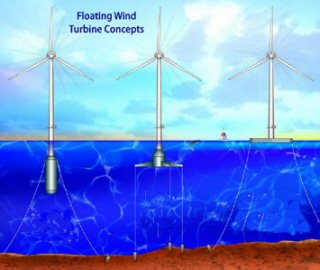
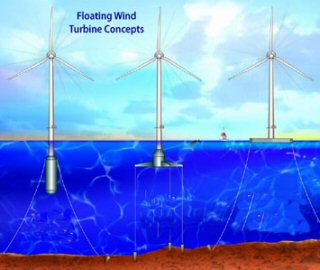
So Sclavounos and his MIT colleagues teamed up with wind-turbine experts from the National Renewable Energy Laboratory (NREL) to integrate a wind turbine with a floating platform. Their design calls for a tension leg platform (TLP), a system in which long steel cables (tethers) connect the corners of the platform to a mooring system on the seabed.
According to their analyses, the floater-mounted turbines could work in water depths ranging from 30-200 meters. In the Northeast United States, for example, they could be 50-150 kilometers from shore. And the turbine atop each platform could be very large, a powerful economic advantage in the wind-farm business. The new offshore design assumes a 5.0 megawatt (MW) experimental turbine, whereas current onshore units are 1.5 MW and offshore units, 3.6 MW.
Because of their size (the rotors would be 140 meters in diameter), the researchers anticipate that the turbines will be assembled onshore and towed out to sea. To keep each platform stable, cylinders inside it are ballasted with concrete and water. Once on site, the platform is hooked to previously installed tethers. Water is pumped out of the cylinders until the entire assembly lifts up in the water, pulling the tethers taut.
The tethers allow the floating platforms to move from side to side but not up and down – a remarkably stable arrangement, says Sclavounos. According to computer simulations, in hurricane conditions the floating platforms – each about 30 meters in diameter – would shift by only 1 – 2 meters, and the bottom of the turbine blades would remain well above the peak of even the highest wave.
Sclavounos hopes to install a half-scale prototype south of Cape Cod. “We’d have a little unit sitting out there and… could show that this thing can float and behave the way we’re saying it will,” he said. “That’s clearly the way to get going.”
Source: MIT News
Pic courtesy National Renewable Energy Laboratory