
Home   |   Sci News   |   Discussion Forum   |   Books, Books, Books   |   Curiosity Shop
Discussion Forums
General Science

Not-Quite Science

Physics

Climate Change

Science Fiction

Past Forums

Search
Custom Search
Sponsored Links
News And Research

Animal Kingdom

Biology

Climate Change

Environment

Evolution

Genetics

Humans

Mind & Brain

Prehistory

Health & Diet

Health Threats

Health & Environment

Health: From The Lab

Mental Health

Reproductive Health

Energy Alternatives

Chemistry

Computing & Electronics

Nanotechnology

Pimping Nature

Robotics & AI

Physics

Space


Science Shopping
Sci Shop
Peculiar and bizarre scientific stuff that you didn't even know existed and you don't need.
Science Books
Book Reviews
Rusty Rockets lists his all-time favorite science titles.
Archives
2010
2009 2008 2007
2006 2005 2004
2003 2002 2001
2000 1999 1998
Feature Archive

Bookmark and Share


17 December 2004
Crocheting Chaos
by Kate Melville

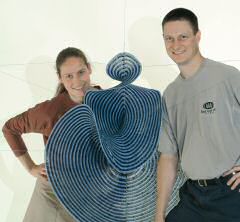
The mathematics journal Mathematical Intelligencer has published some intriguing instructions on how to crochet your very own model of chaos. Hinke Osinga and Bernd Krauskopf - both of Bristol University's Department of Engineering Mathematics - have turned the Lorenz equations that describe the nature of chaotic systems into a real-life object, by crocheting computer-generated instructions.

"Imagine a leaf floating in a turbulent river and consider how it passes either to the left or to the right around a rock somewhere downstream. Those special leaves that end up clinging to the rock must have followed a very unique path in the water. Each stitch in the crochet pattern represents a single point [a leaf] that ends up at the rock," said Osinga (left of picture).

Together all the points (stitches) define a complicated surface, according to the Lorenz equations. Osinga and Krauskopf have developed a method to describe such surfaces using a computer. After months of staring at animations on a screen, they suddenly realised that in fact their computations had naturally generated crochet instructions. Osinga, who learnt to crochet at the age of seven, took up the challenge. "The computer-generated crochet instructions were remarkable. Simply by looking at the real-life surface I would never have designed it the way the computer did. After all those months of trying to create it on screen, it was fascinating to see the surface grow under my own hands," she said. "And it was truly amazing to see a floppy object fall into its desired shape when it was mounted with steel wire," Krauskopf added.

The final result took Osinga about 85 hours to complete and contains 25,511 crochet stitches.

Crochet your own Lorenz manifold at www.enm.bris.ac.uk/anm/preprints/2004r03.html

Pic courtesy University of Bristol

Discuss this article in our forum

Home         All The News      Science Forum         Books, Books, Books         Curiosity Shop         About

The terms and conditions governing your use of this website.
Copyright © 1997 - 2010 Science a Go Go and its licensors. All rights reserved.