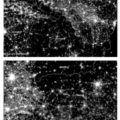

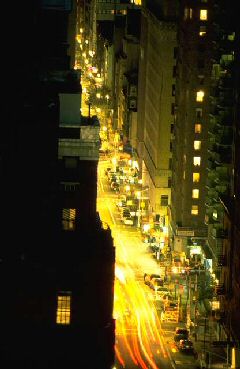
Cities and nature might sound like odd bedfellows, but a new NASA funded study, published in theGeophysical Research Letters journal, has found that urban environments create warmer conditions that cause plants to stay green longer each year. Urban areas with high concentrations of buildings, roads and other artificial surfaces retain heat, creating urban heat islands. Satellite data reveal that urban heat islands increase surface temperatures compared to rural surroundings.
Using information from NASA’s Moderate Resolution Imaging Spectroradiometer (MODIS) instrument on the Terra satellite, Boston University researchers discovered that city climates have a noticeable influence on plant growing seasons up to 10 kilometers away from a city’s edges. Growing seasons in 70 cities in eastern North America were about 15 days longer in urban areas compared to rural areas outside of a city’s influence.
“If you live in a rural area and drive regularly into the city, and if you pay attention to vegetation, you will see a difference in the growing seasons in early spring and late autumn,” said Xiaoyang Zhang, the study’s lead author.
Zhang added that urban heat islands provide a very good model to assess the effects of global warming on plant growing seasons and ecosystems. As temperatures warm due to climate change, growing seasons will likely change as well. Zhang and colleagues found that for every 1 degree Celsius (C) or 1.8 Fahrenheit (F) that temperatures rose on average during the early springtime, vegetation bloomed 3 days earlier.
The researchers used MODIS surface reflectance data to measure seasonal changes in plant growth for the entire year of 2001. By accounting for angles of views from the satellite, varying sunlight, land surface temperatures, cloud cover, and the presence of snow, the scientists were able to detect daily variations in the green color of plants.
Only eastern North American cities with urban areas larger than 10 square kilometers were included in the study. The researchers found that the effect urban heat islands have on plants’ growing seasons is exponentially weaker the further away from the city one travels. Significant effects were seen up to 10 kilometers from city lines. In other words, the impact of urban climates on ecosystems extended out 2.4 times the size of a city itself.
“Warming from global climate change will definitely impact ecosystems,” Zhang said. “Thus, urban areas provide us with some measures of how changes in temperature might affect vegetation,” he added.