Home   |   News   |   Discussion Forum   |   Books   |   Curiosity Shop
Discussion Forum
Recent Posts
Philosophy of Religions--all religions, including,
Revlgking
1 second ago
UK Opens its UFO Files
redewenur
Today at 12:33 AM
How Reliable are those climate models?????
Revlgking
Yesterday at 03:48 PM
Human Influence on Climate
samwik
Yesterday at 11:50 AM
Does science require reproducible experiments?
redewenur
Yesterday at 10:34 AM
Reinventing the Sacred
Revlgking
Yesterday at 09:11 AM
CFL bulb with a Ionic air cleaner ... great idea
paul
05/15/08 09:24 PM
The platypus genome sequenced
redewenur
05/15/08 11:28 AM
The Mystery of Global Warming's Missing Heat
paul
05/15/08 09:34 AM
Biodegradeable oil for use in ground water cooling
paul
05/14/08 08:59 PM
Hot Topics

The Environment

Evolution

Space

Mind/Brain

Electronics

Climate Change


Sponsored Links
Most Read
Hormones Gone Wild
Homo Superior
The Universe As Magic Roundabout
In Space, No One Can Hear You Say "Doh!"
Bow To Your Insect Overlords!
Bionics
Sex And The Schizoid Factor
Delusions And Mental Illness
We Come In Peace – NOT!
Eeew!
Small Penis Syndrome A Big Problem?
Have You Hugged Your Robot Today?
Down On The Farm - Yields, Nutrients And Soil Quality
Cat Parasite Has Global Ambitions
POP Goes The Planet
The Disappearing Male
Missing Link A Tripping Chimp?
Inorganic Dust Formations Alive?
Science Shopping
Sci Shop
Peculiar scientific stuff that you didn't even know existed and you don't need.
News And Research

Physics

Climate Change

Space

Natural World

Health

Technology


All 2008 News

Rusty's Reading List
Sci Books
Join Rusty Rockets for the lowdown on what you should be reading.
Search
Google

Science a GoGo Web
Archives
2008 2007
2006 2005 2004
2003 2002 2001
2000 1999 1998
Discussions
Features


2 March 2005
Cod Numbers Decline 96 Percent
by Kate Melville

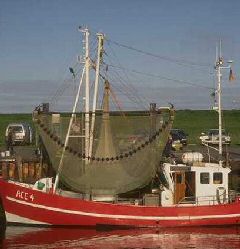
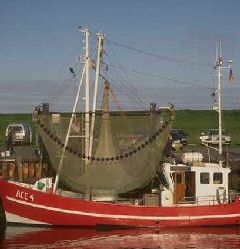
The volume of cod on the Scotian Shelf has plunged 96 percent since the 1850s, say Census of Marine Life scientists. Their research, published in Frontier's in Ecology, is based on old schooner catch records and observations, coupled with modern modeling tools. To estimate long ago fish levels, the researchers used 1850s New England schooner records of daily catch locations and fleet activity on the fishing grounds. The researchers said that fishermen then had "negligible incentive to falsify records" and, combined with ancillary documents, their logs "provide a solid, reliable basis for stock assessment." The findings may have profound implications for contemporary policy makers trying to rebuild fishery "remnants" and restore marine ecosystems.

The researchers say evidence for what constitutes a healthy fish population remains controversial. In rebuilding fisheries, decisions should reflect real and realistic goals for management, not just recently observed catch levels, they said. "Our historical analyses indicate that recent levels of biomass and catch may grossly under-represent the productive potential of commercially important species," said researcher Andrew A. Rosenberg.

Using a mathematical formula, the researchers estimated cod biomass on the Scotian Shelf was 1.26 million metric tons in 1852, compared with less than 50,000 metric tons today, the adults within which represent 3,000 metric tons, or 6 percent. The study notes the estimate of 1850 cod biomass is "quite conservative" as the old fishing logs only record adult cod. "Prevalent hook sizes in this deepwater fishery made landing smaller juvenile cod very unlikely," said Rosenberg. "Despite stringent regulations for the last 6-10 years and a slight rebuilding of fish stocks, the best estimate of adult cod biomass on the Scotian Shelf today comprises a mere 38 percent of the catch brought home by 43 schooners in 1855. In other words, 16 small schooners from this mid 19th century fleet could contain all of the adult cod on the Scotian Shelf today."

The estimated abundance of cod in 1850 is consistent with earlier research led by fellow Census of Marine Life scientist Ransom Myers that estimated how much cod could be sustained in the North Atlantic ecosystem. "Biomasses for many key marine species that are also valuable economic commodities probably follow the pattern we have estimated for this cod population. That is, biomass of commercially important species today is only a small fraction of what existed before industrialized exploitation," the researchers concluded.

Read more about marine animal populations at
HMAP


Home   |   News   |   Discussion Forum   |   Books   |   Curiosity Shop   |   About
The terms and conditions governing your use of this website.
Copyright © 1997 - 2008 Science a Go Go and its licensors. All rights reserved.