
9 June 2005
It Came From Outer Space
By Rusty Rockets
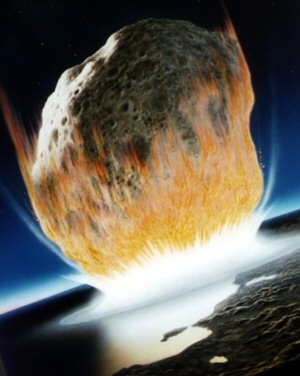 In 1953, a scientist named Stanley Miller demonstrated to the world that running an electric current - representing lightning - through a mixture of methane, ammonia, hydrogen gas and water could create amino acids and simple carbohydrates. Miller, perhaps taking his cue from Mary Shelley's Frankenstein, believed that he had proved life could spontaneously erupt from the most basic of ingredients already available here on Earth. While this is what some scientists would have us believe, there is another possible scenario for the creation of life on Earth; perhaps it came from outer space.
X Files babble aside, it's possible that bacteria (prokaryotes) traveling through space on comets, were the building blocks for all life on Earth. The idea that life on Earth arrived from space is called Panspermia and is backed by a number of high-profile scientists. Like dark matter and dark energy, it's difficult to prove one way or the other, but hotly contested evidence concerning whether there was, or is, life on Mars may provide evidence of life-creating space invaders.
There is actually quite a strong case for the proposition that bacteria contained within comets and asteroids colonized and seeded the Earth for life. Pod people? Not quite. In 1996 NASA made public their claim that life may once, or still does, exist on Mars. Some in the science community have contested the evidence, but the NASA team was very sure that what they had in their possession were 3.6 billion year old fossilized 'bacteria-like' organisms. There are also more recent reports that show Mars is constantly subjected to showers of comets and meteors. But if this is so, why has life not developed on Mars as it has here on Earth? Scientists say they don't know what the atmosphere was like four billion years ago, but the Earth is unique among other planets in our solar system because of the relatively high levels of oxygen. So, perhaps the nature of the environment might determine the type of life that it eventually sustains.
One question that may dampen the enthusiasm of anyone who likes the idea of having alien ancestors is the time, distance and hostile environments that bacteria would have to survive to get to Earth. But as it turns out, this isn't such a problem as bacteria travel extremely well. In his book Beginnings of Cellular Life, Harold Morowitz convincingly argues that bacteria can survive many hundreds of billions of years in hostile environments. And many types of bacteria can handle the extreme heat and cold that might be experienced in comets and asteroids. For example, Thermus thermophilus a hyperthermophile bacterium, can withstand great extremes of temperature. Another factor that may sustain the life of comet bound organisms can be found in Einstein's theory of special relativity. Simply stated, a body traveling at a high-velocity would significantly increase the life span of any hitch-hiking bacteria. Unlike wrinkle creams, high-speed journeys can keep you young.
If life really did come to Earth from space-borne bacteria then an even more fundamental question arises. Where did the bacteria come from in the first place? Perhaps our own probes traveling into deep space will answer that question. And who knows, perhaps those probes are carrying some bacteria from a NASA technician which will one day colonize a far-away planet!
References
http://astrobiology.arc.nasa.gov/news/expandnews.cfm?id=1033
http://www.accessexcellence.org/WN/NM/miller.html
http://www.abc.net.au/news/newsitems/200506/s1382525.htm
http://www.esa.int/esaSC/SEMK6ES1VED_exploring_2.html
http://www2.jpl.nasa.gov/snc/nasa1.html