Home   |   News    |   Discussions   |   Books   |   Curiosities
Search
Custom Search
Popular Reads

Earthquakes and animal behavior
LHC may produce time travelling particles
Country boys boast bigger junk
Running the numbers on alien life
Uh-oh, placebo
Forgetful? Blame your house
Pill to blame for rise in prostate cancer?
Cat parasite has global ambitions
Carbon monoxide keeps city dwellers happy
Magnetic field alters moral judgments
Stars manufacturing organic matter?
Unnatural selection: Courtesy of The Pill
Men 2% funnier than women
Parasite rewires sexual attraction
Novel psychiatric drugs take aim at gut bacteria
Discussions
General Science

Not-Quite Science

Physics

Climate Change

Science Fiction

Past Forums

Sponsored Links
Browse

Animal Kingdom

Biology

Climate Change

Environment

Evolution

Genetics

Humans

Mind & Brain

Prehistory

Health & Diet

Health Threats

Health & Environment

Health: From The Lab

Mental Health

Reproductive Health

Energy Alternatives

Chemistry

Computing & Electronics

Nanotechnology

Pimping Nature

Robotics & AI

Physics

Space


Curiosities
Sci Shop
Peculiar and bizarre scientific stuff that you didn't even know existed and you don't need.
Books
Book Reviews
Rusty Rockets lists his all-time favorite science titles.
Archives
2012 2011 2010
2009 2008 2007
2006 2005 2004
2003 2002 2001
2000 1999 1998
Feature Archive


22 June 2010
Synthetic antibodies successfully tested in mammals
by Kate Melville

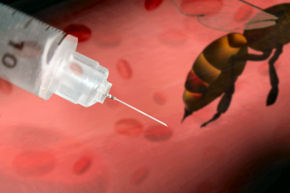
Researchers from the University of California - Irvine (UCI) have created the first "plastic antibodies" to be successfully employed in live organisms - stopping the spread of bee venom through the bloodstream of mice.

The tiny polymeric particles - just 1/50,000th the width of a human hair - were designed to match and encase melittin, a peptide in bee venom that causes cells to rupture. Large quantities of melittin can lead to organ failure and death.

The polymer nanoparticles were prepared by molecular imprinting, a technique similar to plaster casting. UCI chemistry professor Kenneth Shea and project scientist Yu Hoshino linked melittin with small molecules called monomers, solidifying the two into a network of long polymer chains. After the plastic hardened, they removed the melittin, leaving nanoparticles with minuscule melittin-shaped holes.

When injected into mice given high doses of melittin, these imprinted nanoparticles enveloped the matching melittin molecules, capturing them before they could disperse and wreak havoc, greatly reducing fatalities among the rodents.

"Never before have synthetic antibodies been shown to effectively function in the bloodstream of living animals," noted Shea. "This technique could be utilized to make plastic nanoparticles designed to fight more lethal toxins and pathogens."

Unlike natural antibodies produced by live organisms and harvested for medical use, synthetic antibodies can be created in laboratories at a lower cost and have a longer shelf life. "The bloodstream includes a sea of competing molecules, such as proteins, peptides and cells, and presents considerable challenges for the design of nanoparticles," Shea explained. "The success of this experiment demonstrates that these challenges can be overcome."

Related:
Nanoparticle Laced Wastewater Could Compromise Treatment Plants
New concerns over nanosilver
Nanoparticles Transport Gene Therapy


Source: University of California - Irvine


Social

Follow Science a GoGo


Home         All The News      Science Forum         Books, Books, Books         Curiosity Shop         About

The terms and conditions governing your use of this website.
Copyright © 1997 - 2012 Science a Go Go and its licensors. All rights reserved.