
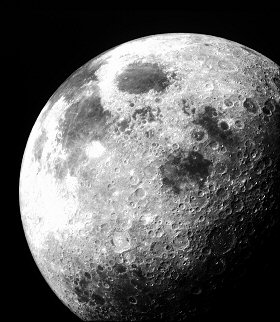
When Apollo astronauts returned from the moon 40 years ago, they brought back moon rocks to undergo analysis, and one of the big questions was whether there was water to be found in the lunar rocks and soils. But most of the rock boxes containing the lunar samples had leaked. This led the scientists to assume that the trace amounts of water they found came from Earth air that had entered the containers. Since then it was believed that there was virtually no water on the moon.
Now, forty years later, a team of scientists has found evidence that the old assumption may be wrong. “To some extent, we were fooled,” said Larry Taylor of the University of Tennessee, Knoxville. “Since the boxes leaked, we just assumed the water we found was from contamination with terrestrial air.”
Taylor and the other researchers used NASA’s Moon Mineralogy Mapper – M3 for short – housed on the Indian Chandrayyan-1 satellite, to make the new discovery. M3 analyzes the way that light from the sun reflects off the lunar surface to understand what materials comprise the lunar soil – a technique known as reflectance spectrometry. In this case, the instrument detected wavelengths of reflected light that would indicate a chemical bond between hydrogen and oxygen.
The instrument can only see the very uppermost layers of the lunar soil – perhaps to a few centimeters below the surface, but what it saw, according to Taylor, was water. What scientists did not understand, though, was where this newly observed water came from.
Since the rocks and soils that compose the moon contain about 45 percent oxygen, mostly combined in silicate phases, the question before researchers is where the hydrogen component of the water they’re seeing with M3 came from. In this case, they believe it may have come from the solar wind. Taylor said the oxygen-rich minerals and glasses on the surface of the moon are constantly pounded by hydrogen in the form of protons, moving at velocities of one-third the speed of light.
When those protons hit the lunar surface with enough force, suspects Taylor, they break apart oxygen bonds in soil materials, and where free oxygen and hydrogen are together, there’s a high chance that trace amounts of water will be formed. These traces are thought to be about a quart of water per ton of soil.
Taylor and other M3 team members believe their findings will be of particular significance as mankind continues to plan for a return to the moon. The maps created by M3 could provide mission planners with locations prime for extraction of needed water from the lunar soil.
Related:
Moon Dust Could Be Key Ingredient For Giant Lunar Telescope
In Space, No One Can Hear You Say “Doh!”




Comments are closed.