
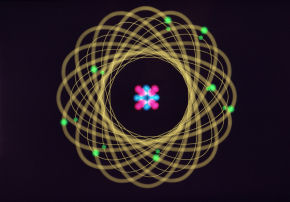
Physicists from the Universities of Cambridge and Birmingham have shown that electrons, which are indivisible in isolation, can divide into two new particles called spinons and a holons when crowded into in a narrow wire.
Reporting on their work in Science, the researchers explained that while single electrons seem to be impossible to break apart, this does not seem to be the case when electrons are brought together. Instead, the like-charged electrons repel each other and need to modify the way they move to avoid getting too close to each other. In ordinary metals this does not usually make much difference to their behavior. However, if the electrons are put in a very narrow wire the effects are exacerbated as the electrons find it much harder to move past each other.
Nearly three decades ago, physicist Duncan Haldane conjectured that under these circumstances and at the lowest temperatures the electrons would always modify the way they behaved so that their magnetism and their charge would separate into two new types of particle called spinons and holons.
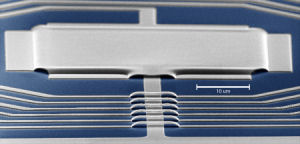
The challenge today’s researcher team faced was to confine electrons tightly in a “quantum wire” and bring this wire close enough to an ordinary metal so that the electrons in that metal could “jump” by quantum tunneling into the wire. By observing how the rate of jumping varies with an applied magnetic field the experiment reveals how the electron, on entering the quantum wire, has to fall apart into spinons and holons. The conditions to make this work comprised a comb of wires above a flat metal cloud of electrons. The Cambridge physicists, Yodchay Jompol and Chris Ford, clearly saw the distinct signatures of the two new particles as the Birmingham theorists, Tim Silk and Andy Schofield, had predicted.
‘What is remarkable about this new experiment is not just the clarity of the observation of the spinon and holon, which confirms some earlier studies, but that the spinon and holon are seen well beyond the region that Duncan Haldane originally conjectured,” added Schofield. “Whether we will be able to control these new particles as successfully as we have the single electron remains to be seen. What it does reveal is that bringing electrons together can lead to new properties and even new particles.”
Related:
Novel material could revolutionize electronics
Moore’s Law No More?
Getting A Handle On Spintronics
Radical Transistor Design Blasts Single Electrons Through Circuits

Comments are closed.