
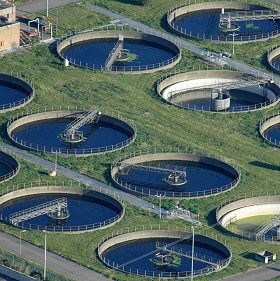
In the first study of its kind, University of Michigan researchers have established that wastewater treatment plants are providing a perfect environment for the emergence of antibiotic-resistant superbugs that eventually end up in neighboring streams and lakes.
Chuanwu Xi and co-researchers, of the University of Michigan School of Public Health, sampled water containing the bacteriaAcinetobacter at five sites in and near Ann Arbor’s wastewater treatment plant. They found the so-called superbugs – bacteria resistant to multiple antibiotics – up to 100 yards downstream from the discharge point into the Huron River. But Xi is cautious about what risk, if any, the presence of superbugs in aquatic environments poses to humans. “We still need to understand the link between aquatic and human multiple drug resistant bacteria,” said Xi.
Xi found that while the total number of bacteria left in the final discharge effluent declined dramatically after treatment, the remaining bacteria was significantly more likely to resist multiple antibiotics than bacteria in water samples upstream. Some strains resisted as many as seven of eight antibiotics tested. The bacteria in samples taken 100 yards downstream also were more likely to resist multiple drugs than bacteria upstream.
Xi explained that the problem isn’t that treatment plants don’t do a good job of cleaning the water – it’s that they simply aren’t equipped to remove all antibiotics and other pharmaceuticals entering the treatment plants. The treatment process is fertile ground for the creation of superbugs because it encourages bacteria to grow and break-down organic matter. However, the good bacteria grow and replicate along with the bad. In the confined space, bacteria share resistant genetic materials, and remaining antibiotics and other stressors may select multi-drug resistant bacteria.
The next step, said Xi, is to see how far downstream the superbugs survive and try to understand the link between aquatic and human superbugs.
Related:
Wastewater Reveals A Cocaine Surprise
Nanoparticle Laced Wastewater Could Compromise Treatment Plants
Grandpa’s Soap Alive And Kicking
Waterways Awash With Anti-Bacterial Chemical
Hormones Gone Wild
Source: University of Michigan
Related posts:
 Nil by mouth: oral ingestion blamed for rapid rise of antibiotic resistance
 Intriguing evidence of charitable behavior in bacteria
 Bacteria found to exhibit anticipatory behavior
 High Levels Of Antibiotic Resistance In Arctic Birds
 Prevalence Of Antibiotic Resistance Surprises
 Halting Evolution To Fight Illness

Comments are closed.