

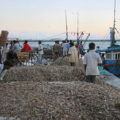
While many of the world’s fisheries are in serious decline, the coastal Mediterranean fishery off the Nile Delta has expanded dramatically since the 1980s, thanks to sewage and fertilizer run-off which has caused an explosion in fish numbers.
According to Autumn Oczkowski, a researcher at the University of Rhode Island Graduate School of Oceanography, 60 to 100 percent of the current fishery production is supported by nutrients from fertilizer and sewage. Her research appears in the Proceedings of the National Academy of Sciences.
Oczowski explained that the fishery expansion was preceded by a collapse in fish numbers triggered by the completion of the Aswan High Dam in 1965. Historically, the Nile would flood the delta every fall, irrigating nearby agricultural land and then flowing out to the Mediterranean, carrying with it nutrients to support a large and productive fishery. Construction of the dam stopped the flooding, and the fishery collapsed.
As a result, landings of fish in coastal and offshore waters are more than three times pre-dam levels. While increased fishing effort in recent years may have played some role in the recovery, Oczkowski’s findings indicate that anthropogenic nutrient sources have now more than replaced the fertility carried by the historical flooding. And the results have also raised questions among many scientists about the value of anthropogenic sources of nutrients to ecosystems.
“We’re programmed in the West to think of nutrient enrichment of coastal systems as bad,” Oczkowski said. “Here in Rhode Island we’ve spent hundreds of millions of dollars to upgrade sewage plants to reduce nutrient loading into Narragansett Bay. And it’s a major issue in the Chesapeake Bay and in the Gulf of Mexico, where run-off of fertilizers from the country’s breadbasket into the Mississippi River has caused a dead zone in the Gulf. But the Egyptians don’t think it’s a bad thing. For them, it’s producing tons of fish and feeding millions of hungry people. It’s forcing us to reconsider whether we can say that nutrient inputs are always a bad thing.”
Related:
One-third of world’s fish catches being needlessly used as animal feed
Slimy Future Predicted For World’s Oceans
Something Fishy About Rocketing Oceanic Nitrogen Levels
Source: University of Rhode Island
Related posts:
 One-third of world’s fish catches being needlessly used as animal feed
 LHC may produce time travelling particles
 First demonstration of coherent control of a quantum multi-resonator architecture
 Global Warming May Trigger Ice Sheet Growth
 Infant Virus May Cause Asthma
 Lack Of Inhibition Strengthens Nicotine Addiction









Comments are closed.