

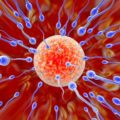
Biologists from Brown University have found that eliminating germline stem cells (the cells that make eggs and sperm) lengthens the life of fruit flies and alters the insects’ insulin production. Writing in the Proceedings of the National Academy of Sciences, the researchers say their findings indicate that molecular signals from the reproductive system affect aging and metabolism in animals – and possibly in humans.
The new findings build on a discovery made 10 years ago by biologist Cynthia Kenyon at the University of California, San Francisco, who found that eliminating germline stem cells in roundworms extended their lifespan. “We wanted to see if Kenyon’s findings could be duplicated in the fly,” said Brown’s Marc Tatar, the senior scientist on the project. “If so, we’d know that reproductive control of lifespan was a general principle in biology.”
In the Brown experiments, the researchers over-activated a gene that controls germline stem cells in flies, a move that eliminated the cells’ production. These sterile flies lived 20 to 50 percent longer than typical flies – results that matched Kenyon’s finding in worms.
But surprisingly, when germline cells were eliminated and the flies lived longer, insulin-producing cells in the fly brain actually made more insulin. When the researchers studied the flies’ tissues, they discovered something intriguing: Even though the brains were making more insulin, the bodies were responding as if there was less insulin present.
Tatar suggests that this paradoxical finding might be explained by the insects’ gonads (testes or ovaries) producing a protein that acts like a sponge. This protein binds to the insulin and blocks its signals throughout the body. So the flies respond as if there is low, not high, insulin circulation inside their bodies. “This suggests that the gonad and the brain are in a synchronized hormonal feedback loop,” Tatar said. “It’s not just the brain affecting the gonad, but also the other way around.” The researchers believe a similar communication mechanism between the brain and the gonads might occur in mammals.
Related:
Anti-Aging Finding Turned On Its Head
Epilepsy Drugs Slow Aging














Comments are closed.