
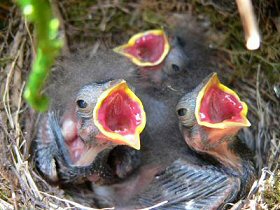
Ramping up testosterone production can help male birds win a mate, but it also turns them into bad dads, who are uninterested in parenting their young. Such are the perils of masculinity amongst dark-eyed juncos, as reported in The American Naturalist by researchers from Indiana University, the University of Virginia and the University of Southern Mississippi.
The researchers say this is the first study to examine, in the wild, the way in which natural changes in testosterone levels determine how a male spends his time. Interestingly, it’s a bit more complex than simply the total amount of testosterone in a male bird that determines his tendency toward aggression and monogamy. Apparently, it’s how much and how quickly his testosterone levels rise and fall that determines whether he’s the kind to stick around and take care of his young. The male juncos whose testosterone levels were more stable were more likely to invest more time and energy in parenting.
Ketterson added that it was a classic trade-off in evolutionary biology: males have a certain amount of energy and time they can invest in attracting mates and sticking around to parent offspring. Under certain circumstances it may be beneficial for male birds to “love ’em and leave ’em,” maximizing the number of female partners during a mating season. Under other circumstances, it may be in the male junco’s best interests to mate with only one female and stick around until the chick is old enough to fend for itself.
“The results are exciting because they show us how animals that make different choices might differ from each other on a physiological level. On an evolutionary level, they suggest that there may often be more than one right choice, depending on the circumstances,” co-researcher Joel McGlothlin said.
So, is testosterone calling all the shots? “It is surely more complicated than that,” Ketterson mused. “The link between testosterone and aggressive and sexual behavior is probably more direct than the link between testosterone and parental behavior. The latter needs much more study. One of the interesting things is that all males stick around and help. If they have higher testosterone they help less. If they have lower testosterone they help more.”
Male juncos pose an interesting evolutionary question. Why wouldn’t one of the behaviors win out over the other? “Variation in behavior may persist because the environment varies,” Ketterson said. “In cold, wet years, or years when lots of predators are attacking young in the nest, good fathers may be more successful at leaving offspring. When food is plentiful and predators are few, males that focus on mating may be more successful. The balance between the two is probably dynamic.”
Ketterson said the next step in the program was to relate variation in testosterone to actual measures of evolutionary fitness – namely lifespan and offspring actually produced. “Is it true that individuals who resolve the trade-off in different ways have equal fitness? Can a good parent be just as successful in an evolutionary sense as a good mater?”
Related:
Testosterone Apocalypse!
Testosterone A Mixed Blessing For Songbirds
Male Scientists Not So Manly

















Comments are closed.