
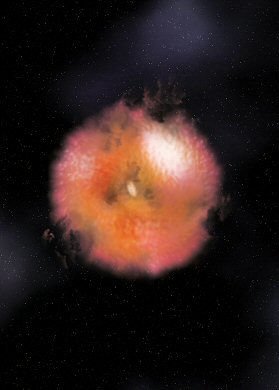
Reporting in Astrophysical Journal Letters, astronomers using NASA’s Swift satellite and the Japanese Suzaku X-ray observatory say they has discovered a new class of active galactic nuclei (AGN).
AGN such as quasars, blazars, and Seyfert galaxies are powered by supermassive black holes and are among the most luminous objects in our Universe, often pouring out the energy of billions of stars from a region no larger than our solar system.
Using Swift and Suzaku, the international team have discovered that a relatively common class of AGN has escaped detection – until now. “This is an important discovery because it will help us better understand why some supermassive black holes shine and others don’t,” says team member Jack Tueller, of NASA’s Goddard Space Flight Center.
Evidence for the new type of AGN began surfacing over the past two years. Using Swift’s Burst Alert Telescope (BAT), Tueller found several hundred relatively nearby AGNs that were previously missed because their visible and ultraviolet light was smothered by gas and dust.
Suzaku covers a broader range of X-ray energies than BAT, so astronomers expected Suzaku to see X-rays across a wide swath of the X-ray spectrum. But despite Suzaku’s high sensitivity, it detected very few low- or medium-energy X-rays from these two AGN, which explains why previous X-ray AGN surveys missed them.
Conventional models portray AGNs as surrounded by a donut-shaped ring of material, which partially obscures our view of the black hole. Our viewing angle with respect to the donut determines what type of object we see. But team member Richard Mushotzky, also at NASA, thinks these newly discovered AGN are completely surrounded by a shell of obscuring material. “We can see visible light from other types of AGN because there is scattered light,” says Mushotzky. “But in these two galaxies, all the light coming from the nucleus is totally blocked.”
Another possibility is that these AGN have little gas in their vicinity. In other AGN, the gas scatters light at other wavelengths, which makes the AGN visible even if they are shrouded in obscuring material. “Our results imply that there must be a large number of yet unrecognized obscured AGNs in the local universe,” noted Ueda.
The astronomers say that these objects might comprise about 20 percent of the X-ray radiation that pervades our Universe. NASA’s Chandra X-ray Observatory has found that this background is actually produced by huge numbers of AGNs, but Chandra was unable to identify the nature of all the sources.
“We think these black holes have played a crucial role in controlling the formation of galaxies, and they control the flow of matter into clusters,” says Tueller. “You can’t understand the universe without understanding giant black holes and what they’re doing. To complete our understanding we must have an unbiased sample.”
Related articles:
Orphan Black Hole Puzzles Astronomers
Have Black Holes Reached Their Use-By-Date?
Massive “Blazar” Black Hole Sheds Light On Big Bang




Comments are closed.