Home   |   News   |   Discussion Forum   |   Books   |   Curiosity Shop
Discussion Forum
Science Talk
Discuss scientific conundrums with our motley band of bamboozled boffins.
Hot Topics

The Environment

Evolution

Space

Mind/Brain

Electronics

Climate Change


Search
Custom Search
Sponsored Links
Most Read
Hormones gone wild
Homo superior
The universe as magic roundabout
In space, no one can hear you say "doh!"
Bow to your insect overlords!
Bionics
Sex and the schizoid factor
Delusions and mental illness
We come in peace – not!
Eeew!
Small penis syndrome a big problem?
Have you hugged your robot today?
Down on the farm - yields, nutrients and soil quality
Cat parasite has global ambitions
Pop goes the planet
The disappearing male
Missing link a tripping chimp?
Inorganic dust formations alive?
Science Shopping
Sci Shop
Peculiar scientific stuff that you didn't even know existed and you don't need.
News And Research

Physics

Climate Change

Space

Natural World

Health

Technology


All 2008 News

Rusty's Reading List
Sci Books
Join Rusty Rockets for the lowdown on what you should be reading.
Archives
2008 2007
2006 2005 2004
2003 2002 2001
2000 1999 1998
Discussion Archive
Feature Archive


24 July 2007
Writer's Cramp A Sign Of Brain Abnormalities
by Kate Melville

Compared to healthy individuals, people with serious cases of writer's cramp have less brain tissue in areas of the brain that connect with the affected hand, say French researchers in the latest issue of Neurology.

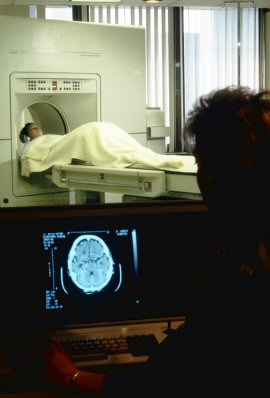
Writer's cramp - a form of dystonia - is an involuntary, sustained muscle contraction that sometimes occurs in people who have used the same muscles repeatedly for years. The new study involved people who had writer's cramp for an average of seven years with no other forms of dystonia. Using brain imaging, the researchers compared the brains of those with writer's cramp to a healthy control group.

They found that those with writer's cramp had less grey matter in three areas of the brain: the cerebellum, the thalamus, and the sensorimotor cortex. "It's not clear whether these abnormalities are a cause or a result of the disease," said study author Stéphane Lehéricy, of Salpêtrière Hospital in Paris. "The fact that the brain abnormalities are in the areas that control the affected hand suggests that these differences are specific to this problem."

But another theory is that the brain structure changed and adapted as a result of the sustained repetitive movement. "Studies have shown that people with no dystonia can experience brain changes due to learning new information, which supports this theory," noted Lehéricy.

Related articles:
Tourette's Sufferers Enjoy Superior Grammar Skills
Trauma The Major Cause Of Schizophrenia?

Source: American Academy of Neurology


Home            News            Discussion Forum            Books            Curiosity Shop            About

The terms and conditions governing your use of this website.
Copyright © 1997 - 2008 Science a Go Go and its licensors. All rights reserved.