Home   |   News   |   Discussion Forum   |   Books   |   Curiosity Shop
Discussion Forum
Recent Posts
Optica! (May 12, 2008)
benito
Yesterday at 10:31 PM
Mars landing in 21 Days
odin1
Yesterday at 07:35 PM
Philosophy of Religions--all religions, including,
Ellis
Yesterday at 06:26 PM
The platypus genome sequenced
redewenur
Yesterday at 02:49 PM
Zealotry over Global Warming
RicS
Yesterday at 08:41 AM
edge of space; plausible
Mike Kremer
05/11/08 10:05 AM
How Reliable are those climate models?????
Canuck
05/10/08 06:38 PM
Biofuels Starve the Poor
redewenur
05/10/08 08:00 AM
Artic Ice Free by 2013 !!
samwik
05/10/08 01:07 AM
Semantics, Etymology, Syntactics, Etc.
samwik
05/10/08 12:10 AM
Hot Topics

The Environment

Evolution

Space

Mind/Brain

Electronics

Climate Change


Sponsored Links
Most Read
Hormones Gone Wild
Homo Superior
The Universe As Magic Roundabout
In Space, No One Can Hear You Say "Doh!"
Bow To Your Insect Overlords!
Bionics
Sex And The Schizoid Factor
Delusions And Mental Illness
We Come In Peace – NOT!
Eeew!
Small Penis Syndrome A Big Problem?
Have You Hugged Your Robot Today?
Down On The Farm - Yields, Nutrients And Soil Quality
Cat Parasite Has Global Ambitions
POP Goes The Planet
The Disappearing Male
Missing Link A Tripping Chimp?
Inorganic Dust Formations Alive?
Science Shopping
Sci Shop
Peculiar scientific stuff that you didn't even know existed and you don't need.
News And Research

Physics

Climate Change

Space

Natural World

Health

Technology


All 2008 News

Rusty's Reading List
Sci Books
Join Rusty Rockets for the lowdown on what you should be reading.
Search
Google

Science a GoGo Web
Archives
2008 2007
2006 2005 2004
2003 2002 2001
2000 1999 1998
Discussions
Features


7 September 2006
Pleistocene Era Methane Adds To Greenhouse Misery
by Kate Melville

A Florida State University (FSU) scientist says that as the permafrost in Northern Siberia melts because of climate change, methane frozen there since the Pleistocene era will be released into the atmosphere, further fueling the greenhouse effect.

FSU's Jeff Chanton explained that methane's contribution to the greenhouse effect is more than 20 times that of carbon dioxide. Even worse, the methane now melting after 40,000 years will encourage a feedback mechanism, warming the climate and releasing even more of the methane. The study, published in Nature, paints a gloomy picture of permafrost decomposition accelerating further because of this feedback mechanism. "This is not good for the quality of human life on Earth," Chanton lamented.

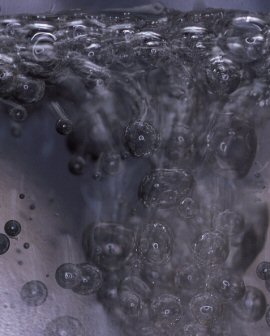
Measuring the methane bubbling from two Siberian lakes revealed the world's northern wetlands as a much larger potential source of atmospheric methane than previously believed. Worryingly, Chanton's findings have increased these estimates by up to 63 percent.

Chanton said that understanding the contribution of North Siberia thaw lakes to global atmospheric methane is critical, because the concentration of that potent greenhouse is highest at that latitude. Additionally, methane levels have risen sharply in recent decades and exhibit a significant seasonal jump at those high northern latitudes.

Chanton believes the thawing permafrost along the margins of the thaw lakes are the primary source of methane released in the region. "My fellow researchers and I estimate that an expansion of these thaw lakes between 1974 and 2000, a period of regional warming, increased methane emissions by 58 percent there," said Chanton. "Because the methane now emitted in our study region dates to the Pleistocene age, it's clear that the process, described by scientists as 'positive feedback to global warming,' has led to the release of old carbon stocks once stored in the permafrost."

Source: Florida State University


Home   |   News   |   Discussion Forum   |   Books   |   Curiosity Shop   |   About
The terms and conditions governing your use of this website.
Copyright © 1997 - 2008 Science a Go Go and its licensors. All rights reserved.