Home   |   News   |   Discussion Forum   |   Books   |   Curiosity Shop
Discussion Forum
Recent Posts
About physics and consistency of mathematical theo
Adib Ben Jebara
01:04 AM
Atemporal Universe?
amrito
12:50 AM
Philosophy of Religions--all religions, including,
redewenur
10:00 PM
About time for elementary particles
redewenur
09:44 PM
What Would We Choose To Do If...
Ellis
06:07 PM
The Big Crunch will happen after an infinite time
Zephir
02:02 AM
There always existed a universe
Zephir
01:26 AM
Getting to rational eco-footprint levels?
samwik
12:53 AM
Terra Preta Soils to Save the Biosphere
samwik
07/17/08 11:05 PM
Type I civilization: can we make it?
Ellis
07/17/08 10:14 PM
Hot Topics

The Environment

Evolution

Space

Mind/Brain

Electronics

Climate Change


Search
Custom Search
Sponsored Links
Most Read
Hormones Gone Wild
Homo Superior
The Universe As Magic Roundabout
In Space, No One Can Hear You Say "Doh!"
Bow To Your Insect Overlords!
Bionics
Sex And The Schizoid Factor
Delusions And Mental Illness
We Come In Peace – NOT!
Eeew!
Small Penis Syndrome A Big Problem?
Have You Hugged Your Robot Today?
Down On The Farm - Yields, Nutrients And Soil Quality
Cat Parasite Has Global Ambitions
POP Goes The Planet
The Disappearing Male
Missing Link A Tripping Chimp?
Inorganic Dust Formations Alive?
Science Shopping
Sci Shop
Peculiar scientific stuff that you didn't even know existed and you don't need.
News And Research

Physics

Climate Change

Space

Natural World

Health

Technology


All 2008 News

Rusty's Reading List
Sci Books
Join Rusty Rockets for the lowdown on what you should be reading.
Archives
2008 2007
2006 2005 2004
2003 2002 2001
2000 1999 1998
Discussions
Features


26 January 2006
Metals Shortage Looming
by Kate Melville

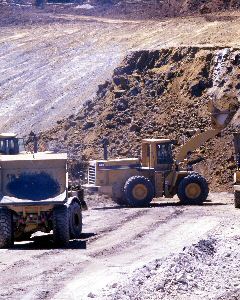
A new study by Yale researchers into the supply and usage of copper, zinc and other metals has determined that supplies of these resources - even if recycled - may fail to meet the needs of the global population. The researchers say that even the full extraction of metals from the Earth's crust and extensive recycling programs may not meet future demand if all countries try and attain the same standard of living enjoyed in developed nations.

Yale researchers, Robert Gordon and Thomas Graedel, based their study on metal still in the Earth, in use by people and lost in landfills. Using copper stocks in North America as a starting point, the researchers tracked the evolution of copper mining, use and loss during the 20th century. The researchers then applied their findings and additional data to an estimate of global demand for copper and other metals if all nations were fully developed and used modern technologies.

The study, appearing in the Proceedings of the National Academy of Sciences, found that all of the copper in ore, plus all of the copper currently in use, would be required to bring the world to the level of the developed nations for power transmission, construction and other services and products that depend on copper.

Globally, the researchers estimate that 26 percent of extractable copper in the Earth's crust is now lost in non-recycled wastes; while lost zinc is estimated at 19 percent. Interestingly, the researchers said that current prices do not reflect those losses because supplies are still large enough to meet demand, and new methods have helped mines produce material more efficiently.

While copper and zinc are not at risk of depletion in the immediate future, the researchers believe scarce metals - such as platinum - risk depletion in this century because there is no suitable substitute for use in devices such as catalytic converters and hydrogen fuel cells. And because the rate of use for metals continues to rise, even the more plentiful metals may face similar depletion risks in the not too distant future.

"There is a direct relation between requisite stock, standard of living and technology in use at a given time," said Gordon. Studying the metal lifecycle from cradle to grave, "provides a different approach to studying use of finite resources - one that is more directly related to environmental concerns than are the discussions found in the economics literature," he concluded.

Source: Yale University


Home   |   News   |   Discussion Forum   |   Books   |   Curiosity Shop   |   About
The terms and conditions governing your use of this website.
Copyright © 1997 - 2008 Science a Go Go and its licensors. All rights reserved.