Home   |   News   |   Discussion Forum   |   Books   |   Curiosity Shop
Discussion Forum
Recent Posts
The platypus genome sequenced
redewenur
Today at 12:55 AM
Philosophy of Religions--all religions, including,
Anonymous
Today at 12:38 AM
edge of space; plausible
Mike Kremer
Yesterday at 10:05 AM
Zealotry over Global Warming
ImranCan
Yesterday at 07:07 AM
How Reliable are those climate models?????
Canuck
05/10/08 06:38 PM
Biofuels Starve the Poor
redewenur
05/10/08 08:00 AM
Artic Ice Free by 2013 !!
samwik
05/10/08 01:07 AM
Semantics, Etymology, Syntactics, Etc.
samwik
05/10/08 12:10 AM
Humanzee? Ape Human Cross
Ellis
05/09/08 11:43 PM
The Mystery of Global Warming's Missing Heat
Mike Kremer
05/09/08 04:12 PM
Hot Topics

The Environment

Evolution

Space

Mind/Brain

Electronics

Climate Change


Sponsored Links
Most Read
Hormones Gone Wild
Homo Superior
The Universe As Magic Roundabout
In Space, No One Can Hear You Say "Doh!"
Bow To Your Insect Overlords!
Bionics
Sex And The Schizoid Factor
Delusions And Mental Illness
We Come In Peace – NOT!
Eeew!
Small Penis Syndrome A Big Problem?
Have You Hugged Your Robot Today?
Down On The Farm - Yields, Nutrients And Soil Quality
Cat Parasite Has Global Ambitions
POP Goes The Planet
The Disappearing Male
Missing Link A Tripping Chimp?
Inorganic Dust Formations Alive?
Science Shopping
Sci Shop
Peculiar scientific stuff that you didn't even know existed and you don't need.
News And Research

Physics

Climate Change

Space

Natural World

Health

Technology


All 2008 News

Rusty's Reading List
Sci Books
Join Rusty Rockets for the lowdown on what you should be reading.
Search
Google

Science a GoGo Web
Archives
2008 2007
2006 2005 2004
2003 2002 2001
2000 1999 1998
Discussions
Features


27 September 2005
Novel “Walking” Molecule Mooted For Nano-Abacus
by Kate Melville

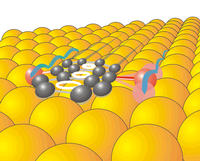
A novel molecule that "walks" like a human could be a key component in future molecular computers. The molecule, known as 9,10-dithioanthracene (DTA), has two linkers that the researchers say act as feet. It obtains energy from heat supplied to it and then moves in a way so that only one of the linkers is lifted from the surface at a time. The remaining linker guides the motion of the molecule and keeps it on a straight course. Alternating the motions of its two linkers, DTA is able to walk in a straight line without the assistance of any external guidance mechanism.

The research team, from the University of California at Riverside, said the molecule's motion was extremely stable. "In tests, DTA took more than 10,000 steps without losing its balance once. Our work proves that molecules can be designed deliberately to perform certain dynamic tasks on surfaces," said research leader Ludwig Bartels. "Similar to a human walking, where one foot is kept on the ground while the other moves forward and propels the body, our molecule always has one linker on a flat surface, which prevents the molecule from stumbling to the side or veering off course."

The walking molecule offers a new approach for storing large amounts of information according to the researchers. Strangely enough, the hardware for such a molecular computer might resemble an abacus. "This offers an easy realization of a concept for molecular computing proposed by IBM in the 1990s, in which every number is encoded by the position of molecules along a line similar to an abacus, but about 10 million times smaller. IBM abandoned this concept, partly because there was no way to manufacture the bars of the abacus at molecule-sized spacing," explained Bartels. But with the guidance problem out of the way, Bartels says that an abacus-like molecular memory using DTA would be more than 1000 times more compact than current silicon devices.

The researchers, whose work will be published in Physical Review Letters, are now working on another component of the abacus, a molecular ratchet, which would convert random thermal oscillation into directed motion. "It would be similar to an automatic watch that rewinds itself on the arm of the bearer - except that it would be just one nanometer in diameter," Bartels said.

Source: University of California at Riverside
Pic courtesy U of C Riverside


Home   |   News   |   Discussion Forum   |   Books   |   Curiosity Shop   |   About
The terms and conditions governing your use of this website.
Copyright © 1997 - 2008 Science a Go Go and its licensors. All rights reserved.