
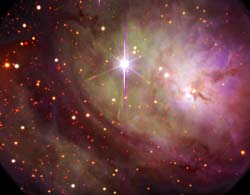
A new telescope on the edge of the Kalahari Desert has just released the first images it has captured of the skies above the southern hemisphere. The Southern African Large Telescope (SALT) was constructed by an international consortium of universities and government agencies. The parties include the National Research Foundation of South Africa, the University of Wisconsin-Madison’s College of Letters and Science, Poland’s Nicolas Copernicus Astronomical Centre and Rutgers University. The $18 million telescope uses 91 hexagonal mirror segments in a 10 meter by 11 meter array.
A huge advantage for the SALT Telescope is its location in one of the darkest regions of the world. With no nearby cities or towns, the observatory will be little affected by the light pollution that hampers many observatories in the Northern Hemisphere.
Wilcots said that the southern sky promised a bounty of observing. Studies of thousands of individual stars in the Magellanic Clouds are planned to trace the history of those nearby galaxies. The results of those studies, Wilcots explains, can be extrapolated to galaxies in general, providing a more refined life history of objects like our own Milky Way.
Other southern sky objects of interest include Eta Carina, a nearby massive star that has been racked by a series of enigmatic and spectacular explosions over the past century; Omega Centauri, a globular cluster of stars in the Milky Way that some astronomers believe may be the fossil remains of another galaxy consumed long ago by the Milky Way; and Centaurus A, a nearby galaxy that recently experienced an explosion at its core.
The astronomers are now integrating into the observatory the primary scientific instrument for the telescope, a device known as the Prime Focus Imaging Spectrograph. When in place above the primary mirror array, the device will give the telescope specialized capabilities to capture and analyze starlight in unprecedented ways. The spectra the astronomers obtain will provide far more information than simple images, helping show the chemical makeup of objects, depict motion, and capture some wavelengths of light that enable the telescope to see through the obscuring clouds of dust and gas that permeate space.
The SALT Observatory, says Wilcots, is “a beacon for Southern African science. It is meant to inspire a new generation of African scientists, which will be the lasting value of SALT to Southern Africa.” He added that there were only a handful, perhaps as few as three, black South Africans with Ph.Ds in astronomy. “While we have problems with an underrepresented minority in science, South Africa has an underrepresented majority.”
Source: University of Wisconsin-Madison
Pic courtesy SALT






Comments are closed.