
The Journal of Molecular Evolution has published a new theory explaining why the language of our genes is more complex than it would seemingly need to be. The work, by researchers at the University of Bath, also suggests that the primordial soup where life began on earth was hot, rather than cold.
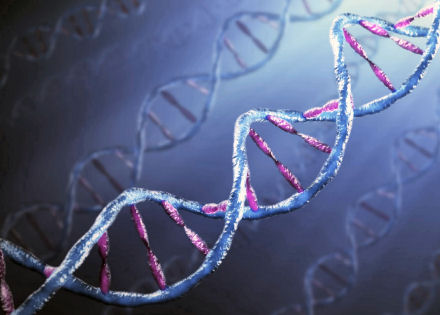
Proteins – the building blocks of life – are produced from DNA using three letter ‘words’, called codons. Codons are then translated into one of 20 amino acids and these are then strung together in the order dictated by the DNA code and folded into complex shapes to form a specific protein. For some time, scientists have been puzzled why there should be 64 codons available in the DNA dictionary, which translate into just 20 amino acids, and why a process that is more complex than it needs to be should have evolved in the first place.
Francis Crick – one of the pioneers who envisioned the structure of DNA – proposed that the three-letter code evolved from a simpler two-letter code. In their research, the University of Bath scientists suggest that the earlier ‘doublet’ code was read in threes – but with only either the first two ‘prefix’ or last two ‘suffix’ pairs of bases being actively read. By combining arrangements of these doublet codes together, the scientists can replicate the table of amino acids – explaining why some amino acids can be translated from groups of 2, 4 or 6 codons.
“When you evolve our theory for a doublet system into a triplet system, you get an exact match up with the number and range of amino acids we see today,” said Dr van den Elsen. “This simple theory explains many unresolved features of the current genetic code. No one has ever been able to do this before, so we are very excited.”
The researchers’ elegant theory also explains how the structure of the genetic code maximizes error tolerance. For instance, ‘slippage’ in the translation process tends to produce another amino acid with the same characteristics, and explains why DNA code is so good at maintaining its integrity. The researchers, including Dr Stefan Babgy and Huan-Lin Wu, emphasized that none of the earlier theories could explain how such an error tolerant structure might have arisen.
Interestingly, the new theory also highlights two amino acids – glutamine and asparagine – that can be excluded from the doublet system and are likely to be relatively recent ‘acquisitions’ by the genetic code. These two amino acids are not tolerant of heat which the researchers believe suggests that heat prevented them from being acquired by the code at some point in the past. One possible reason for this is that the Last Universal Common Ancestor, which evolved into all life on earth, lived in a hot sulfurous pool or thermal vent. As it moved into cooler conditions, it was able to take up these two additional amino acids and evolve into more complex organisms. Dr van den Elsen and colleagues believe this provides further evidence for the idea that life emerged from a hot primordial soup.





Comments are closed.