

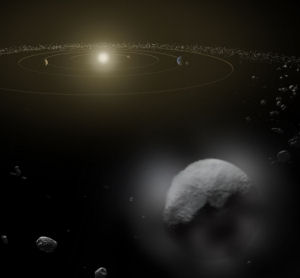
An MIT professor has worked with astronomers to revise the scale used to assess the threat of asteroids and comets colliding with Earth to better communicate those risks with the general public. The team’s goal is to provide easy-to-understand information about a potential doomsday collision with our planet. The Torino scale, similar to the Richter scale used for earthquakes, was adopted by a working group of the International Astronomical Union (IAU) in 1999. On the scale, zero means virtually no chance of collision, while 10 means certain global catastrophe. “The idea was to create a simple system conveying clear, consistent information about near-Earth objects,” or asteroids that appear to be heading toward the planet, said Richard Binzel, a professor at MIT. Critics, however, said that the original Torino scale was actually scaring people, “the opposite of what was intended,” said Binzel. This spurred Binzel and the others to undertake the revisions.
“For a newly discovered near-Earth object, the revised scale still ranks the impact hazard from 0 to 10, and the calculations that determine the hazard level are still exactly the same,” Binzel said. The difference is that the wording for each category now better describes the attention or response merited for each.
The highest Torino level ever given an asteroid was a 4 last December, with a 2 percent chance of hitting Earth in 2029. And after extended tracking of the asteroid’s orbit, it was reclassified to level 0, effectively no chance of collision, “the outcome correctly emphasized by level 4 as being most likely,” Binzel said. “It is just a matter of the scale becoming more well known and understood. Just as there is little or no reason for public concern over a magnitude 3 earthquake, there is little cause for public attention for near-Earth object close encounters having low values on the Torino scale.” He notes that an object must reach level 8 on the scale before there is a certainty of an impact capable of causing even localized destruction.
“The chance of something hitting the Earth and having a major impact is very unlikely. But although unlikely, it is still not impossible. The only way to be certain of no asteroid impacts in the forecast is to keep looking,” Binzel concluded.
More info on the revised scale is available from neo.jpl.nasa.gov/torino_scale.html










Comments are closed.