
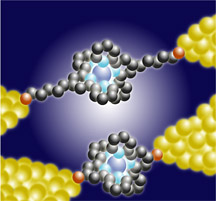
Microscopic scaffolding to house the tiny components of nanotech devices could be built from ribonucleic acid (RNA), the same substance that transports messages around a cell’s nucleus, says a research group at Purdue University. By encouraging RNA molecules to self-assemble into 3-D shapes resembling spirals, triangles, rods and hairpins, the group has found what could be a method of constructing lattices on which to build complex microscopic machines. From such RNA blocks, the group has already constructed arrays that are several micrometers in diameter.
“Our work shows that we can control the construction of three-dimensional arrays made from RNA blocks of different shapes and sizes,” said Peixuan Guo, from Purdue’s School of Veterinary Medicine. “With further research, RNA could form the superstructures for tomorrow’s nanomachines.” The research appears in the journal Nano Letters.
Nanotechnologists, like those in Guo’s group, hope to build microscopic devices with sizes that are best measured in nanometers – or billionths of a meter. Because nature routinely creates nano-sized structures for living things, many researchers are turning to biology for their inspiration and construction tools.
Organisms are built in large part of three main types of building blocks: proteins, DNA and RNA. Of the three, perhaps least investigated and understood is RNA, a molecular cousin to the DNA that stores genetic blueprints within our cells’ nuclei. RNA typically receives less attention than other substances from many nanotechnologists, but Guo said the molecule has distinct advantages. “RNA combines the advantages of both DNA and proteins and puts them at the nanotechnologist’s disposal,” Guo said. “It forms versatile structures that are also easy to produce, manipulate and engineer.”
Since his discovery of a novel RNA that plays a vital role in a microscopic “motor” used by the bacterial virus phi29, Guo has continued to study the structure of this RNA molecule for years. It formed the “pistons” of a tiny motor his lab created several years ago, and members of the team collaborated previously to build dimers and trimers – molecules formed from two and three RNA strands, respectively. “By designing sets of matching RNA molecules, we can program RNA building blocks to bind to each other in precisely defined ways,” he said. “We can get them to form the nano-shapes we want.”
From the small shapes that RNA can form – hoops, triangles and so forth – larger, more elaborate structures can in turn be constructed, such as rods gathered into spindly, many-pronged bundles. These structures could theoretically form the scaffolding on which other components, such as nano-sized transistors, wires or sensors, could be mounted.
“Because these RNA structures can be engineered to put themselves together, they could be useful to industrial and medical specialists, who will appreciate their ease of engineering and handling,” said co-researcher Dieter Moll. “Self-assembly means cost-effective.”
Moll, while bullish on RNA’s prospects, cautioned that there was more work to be done before nanoscale models could be built at will. “One of our main concerns right now is that, over time, RNA tends to degrade biologically,” he said. “We are already working on ways to make it more resistant to degradation so that it can form long-lasting structures.”
“We have not built actual scaffolds yet, just 3-D arrays,” he said. “But we have built them from engineered biological molecules, and that could help us bridge the gap between the living and the nonliving world. If nanotech devices can eventually be built from both organic and inorganic materials, it would ease their use in both medical and industrial settings, which could multiply their usefulness considerably.”






Comments are closed.