Home   |   News    |   Discussions   |   Books   |   Curiosities
Search
Custom Search
Popular Reads

Earthquakes and animal behavior
LHC may produce time travelling particles
Country boys boast bigger junk
Running the numbers on alien life
Uh-oh, placebo
Forgetful? Blame your house
Pill to blame for rise in prostate cancer?
Cat parasite has global ambitions
Carbon monoxide keeps city dwellers happy
Magnetic field alters moral judgments
Stars manufacturing organic matter?
Unnatural selection: Courtesy of The Pill
Men 2% funnier than women
Parasite rewires sexual attraction
Novel psychiatric drugs take aim at gut bacteria
Discussions
General Science

Not-Quite Science

Physics

Climate Change

Science Fiction

Past Forums

Sponsored Links
Browse

Animal Kingdom

Biology

Climate Change

Environment

Evolution

Genetics

Humans

Mind & Brain

Prehistory

Health & Diet

Health Threats

Health & Environment

Health: From The Lab

Mental Health

Reproductive Health

Energy Alternatives

Chemistry

Computing & Electronics

Nanotechnology

Pimping Nature

Robotics & AI

Physics

Space


Curiosities
Sci Shop
Peculiar and bizarre scientific stuff that you didn't even know existed and you don't need.
Books
Book Reviews
Rusty Rockets lists his all-time favorite science titles.
Archives
2012 2011 2010
2009 2008 2007
2006 2005 2004
2003 2002 2001
2000 1999 1998
Feature Archive


31 March 2004
Early Exposure To Toxins Sets Stage For Adult Tumors
by Kate Melville

For gene-environment interactions, the timing of the environmental exposure may be critical, say scientists at the M. D. Anderson Cancer Center.

In a unique animal study presented at the American Association for Cancer Research conference, the researchers found that rats susceptible to developing uterine tumors inevitably developed tumors when exposed to an environmental toxin just three days after birth. A single, three-day exposure was enough to "reprogram" the uterus to respond to normal hormonal signals in a way that promoted tumor growth.

The researchers theorize this new model of gene-environment interaction may go some way in explaining why, in a population of people at the same genetic risk, some develop cancer and others don't.

"In genetically susceptible individuals, exposures that occur early in life may have as great or greater an impact on tumor outcome as those that occur during their adult life," says the study's first author, Jennifer Cook.

Molecular biologist Cheryl Walker, the principal investigator on the study, says the finding "establishes developmental programming as a novel type of gene-environment interaction."

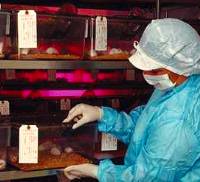
In the experiment, Cook, Walker and a team of other researchers used rats genetically susceptible to developing uterine leiomyoma, the same kind of benign fibroid tumors that many women have. They exposed these rats to a known environmental estrogen, DES, three to five days after birth, a crucial period in development of the animals' reproductive tract. As adults, a little over half of the genetically predisposed rats developed tumors, compared to 100 percent of DES-exposed rats.

Then, the researchers looked at how uterine tissue in exposed animals responded to normal hormones, and found that "the expression of genes regulated by hormones was abnormally high much of the time," says Cook. "A short exposure to an environment estrogen reprogrammed the tissue to be super sensitive to hormones, which drives development of these tumors."

All of the rats shared a common defect in a tumor suppressor gene and had the same genetic susceptibility to developing fibroids, but exposure to the environmental estrogen changed the penetrance of that tumor suppressor gene, and this could theoretically happen within any susceptible population," says Walker. "Hypothetically, an environmental exposure during development of other organs such as the breast could change the penetrance of human tumor susceptibility genes such as BRCA1. This could offer a clue as to why some women with inherited BRCA1 mutations develop cancer, while others don't."


Social

Follow Science a GoGo


Home         All The News      Science Forum         Books, Books, Books         Curiosity Shop         About

The terms and conditions governing your use of this website.
Copyright © 1997 - 2012 Science a Go Go and its licensors. All rights reserved.