
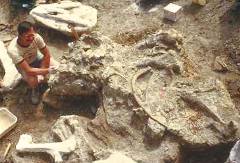
The extinction of the dinosaurs – thought to be caused by an asteroid impact some 65 million years ago – was more likely to have been caused by a ‘mantle plume’ – a huge volcanic eruption from deep within the earth’s mantle, the region between the crust and the core of the earth.
This theory, already supported by a significant body of geologists and palaeontologists, is strengthened by new evidence to be presented at a conference at Cardiff University on the 11th September.
Research by earth scientist, Professor Gerta Keller and her team, suggests that a similar eruption under the Indian Ocean several million years before the extinction of the dinosaurs had a similarly devastating impact on the environment. However, at this earlier time there is no evidence of any asteroid impact.
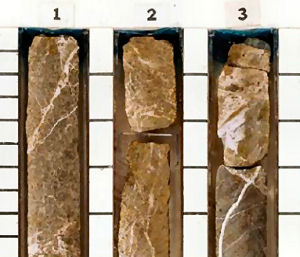
Her findings are based on analysis of microfossil assemblages, which were found inside cores that had been drilled deep into sediments on the ocean floor.
The eruptions that were responsible for these two extinction events were as a result of mantle plumes – a phenomenon caused by rising hot mantle from deep within the earth. Likened to the actions of a lava lamp, the mantle’s heat causes it to rise and mushroom out; it then flattens causing the mantle to melt and erupt magma over the earth’s surface and across an area of some 1,000 kilometres diameter. These eruptions last between one and two million years and more than one million cubic kilometres of lava can be erupted in that time.
“Mantle plumes are literally a hot topic for debate,” said conference organiser Dr Andrew Kerr of Cardiff University’s School of Earth, Ocean and Planetary Sciences. “They are a catalyst for the formation of ocean basins and fundamentally reshaping the earth’s surfaces. The massive outpouring of lava, ashes, and gas can have significant effects on climate, which destabilises the environment and have the potential to dictate the course of evolution. It is likely that were it not for mantle plumes, mammals would not have become predominant, and humankind would not be here today.
“Bizarrely, amongst earth scientists, there is also a vocal minority who don’t believe that mantle plumes exist at all. This conference is therefore an opportunity to address these issues and validity of the links between mantle plumes with the evolution of life by bringing together geophysicists, petrologists and palaeontologists.”









Comments are closed.