
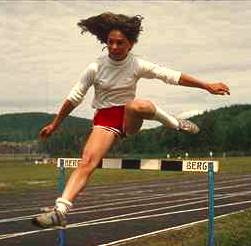
“There is nothing like sport to improve your breathing!” people often say. Yet this is one piece of advice many top athletes must wish they never listened to, as there is no longer any doubt that an alarming proportion of them experience quite the opposite effect: too much training is actually bad for their breathing.
A broad-ranging survey conducted in Norway among 1600 top athletes by the Norwegian University of Sport and Physical Education showed recently just how widespread the damage has been. No less than one athlete in ten — regardless of the type of sport — suffers from asthma or wheeze.
The US Olympic Committee reached similar conclusions after the 1996 summer games in Atlanta. Responding to a questionnaire, 117 out of 700 athletes (or more than 16%) reported suffering from asthma. The worst affected were the cyclists, where the proportion rose to 50%!
On Saturday, the lung experts meeting in Florence also mentioned the damage caused by long-distance running. The organizer of the symposium on Asthma and Sports, Kai-H�kon Carlsen, professor at the Voksentoppen Children’s Asthma and Allergy Center in Oslo, gave the findings of a Finnish survey of 58 marathon runners. The study showed that 15 of the runners (26%) exhibited seasonal bronchial contraction, either in the spring on account of the pollen, or in winter due to the cold. The same research group confirmed the findings with a study of 71 long-distance runners, reaching the conclusion that they were three times more likely to suffer from asthma than ordinary people.
Beware of cross-country skiing in very cold, dry weather conditions!
Paradoxically winter sports attracted most attention in the discussions in Florence, in the light of the recent findings of a survey concerning the 1998 Olympic Games in Nagano. On the basis of carefully controlled physical exercises, researchers of the Olympic Committee of Colorado (USA) were able to show that over a quarter of the athletes on the American team suffered from bronchospasms, in other words spasmodic contractions of the bronchi. What is more, these respiratory problems appeared especially among cross-country skiers, among whom every other skier was affected!
This is an alarming statistic, deplored at the Florence meeting by Dr. Kjell Larsson, of the Department of Labour Medicine in Solna (Sweden), who was one of the first ever to raise the issue. Back in 1993, the Swedish lung expert had already demonstrated that 33 skiers out of 47 showed asthma-related symptoms or diminished respiratory capacity. Those findings were quickly confirmed by Leif Bjermer, professor at the Department of Lung Medicine of the University Hospital of Trondheim (Norway), who also spoke at the Asthma and Sports symposium on Saturday. In a comparison of the prevalence of asthma among 171 Norwegian and Swedish skiers, it turned out once again that every other athlete was affected!
More interesting still was the measurement of bronchial contraction after inhalation of a bronchoconstrictive substance, as only 14% of the Norwegian skiers reacted to the test, compared with three times more of their Swedish neighbours.
This difference is due to climatic reasons, according to the Scandinavian lung experts in Florence. The Norwegian skiers who train near the coast enjoy a more humid climate and therefore run less risk of becoming asthmatic, as opposed to the centrally located Swedes who are exposed to a cold, dry atmosphere.
Kai-H�kon Carlsen insisted that the main cause of the disorders was definitely the intensive training which the skiers had to undergo for many years. Among young 20 year-old cross-country skiers, the proportion of asthmatics is only 7%, a figure that is normal for the population in general. Among athletes who have passed the age of 30, however, the proportion of those affected rises to 20%!
Physical activity is more likely to cause asthma in winter because air temperature plays a crucial role. In a temperate environment (27& #176;), the air breathed by an athlete undergoing intensive training is gently warmed as it enters the airways. But when ice-cold air is breathed in, as in winter conditions in Nordic countries, where outside temperatures can often fall as low as minus 20-25& #176;C, the air inhaled needs much more warming. As this air is also saturated with vapor, major water and heat loss occurs through the heavier breathing required by the athlete’s activity. Due to increased concentration of ionic components in the fluids of the airway mucosa, a mediator release occurs from certain cells in the respiratory tract, causing airway inflammation.
Using a mask
It is important to try to prevent this damage from occurring, and once the asthma has been diagnosed, both environmental and other measures should be taken in order to enable the athletes to continue the sporting activity. One possible measure is using a mask that covers the nose and mouth. Air is exhaled at a temperature of 37& #176;C into a hollow metal grid, where it helps to raise the temperature of the air breathed in, thereby relieving the damage.
Other solutions put forward in Florence included anti-inflammatory prophylactic treatments, like the steroid-based remedies often given to asthmatics, and drugs that can be taken 15 minutes before training, which effectively block the bronchial constriction.
But prevention still remains the best answer, and the lung experts warned especially against undertaking endurance training and competition while subject to respiratory infections.
Related posts:
 Dire new warning on climate from IPCC scientist
 New evidence linking marijuana use to brain abnormalities in adolescents
 Therapy and drugs prove to be effective against body dysmorphia
 Newly detected cosmic noise hints at mysterious events in universe’s past
 Saltwater irrigation trial a success
 Psychiatric disorders common among young adults










Comments are closed.