
19 May 2000
Mutant Mice Drink More Alcohol, Recover Faster
by Kate Melville
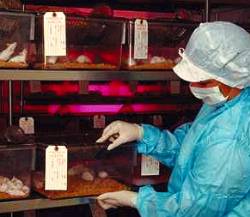 Researchers trying to unravel the causes of alcoholism have discovered that mice voluntarily drink significantly more alcohol when a gene that encodes a key brain protein is missing. In addition, the mice recover more rapidly from the sedative effects of alcohol when given doses that, in humans, would be the equivalent of nearly three times the legal limit for being drunk.
Reporting in tomorrow's edition of The Journal of Neuroscience, University of Washington researchers say that mutant mice bred without the gene that encodes one type of Protein Kinase A (PKA) drank twice as much alcohol as normal mice. The knockout mice, as they are called, also recovered in about 65 minutes from alcohol injections that raised their blood-alcohol levels to 0.275 percent. It took normal mice about 90 minutes to recover from the same amount of alcohol.
"While there is a growing body of evidence suggesting a role for PKA, this is the first direct evidence that PKA is associated with the voluntary consumption of alcohol," said Todd Thiele, who headed the research team along with Stanley McKnight.
"This work is in mice and it may not necessarily be the same in humans," Thiele added. "Additional research will be necessary."
"Thiele's elegant knockout study offers concrete evidence that PKA is involved in regulating voluntary consumption of alcohol and sensitivity to its acute intoxicating effects," said Dr. Enoch Gordis, director of the National Institute on Alcohol Abuse and Alcoholism. "The findings on alcohol sensitivity are intriguing in light of knowledge from human studies that young drinkers with a family history of alcoholism are less sensitive to alcohol's effects than those without a family history."
PKA is a protein that fosters intracellular communication, allowing signals into a brain cell from other brain cells. Several neurotransmitters, or brain chemicals, thought to be involved with drug reward, such as dopamine, recruit PKA signaling. Thus, PKA may be involved with the rewarding effects of alcohol. In the current research, the UW scientists created a knockout strain of mice missing one of the six genes that encode PKA.
To explore the relationship between PKA and alcohol consumption, the UW study housed knockout and normal mice individually. The animals were given food plus water in two bottles. Later water in one of the bottles was replaced with ethanol solutions of 3, 6, 10 and 20 percent. The animals were given each ethanol solution for eight days and their alcohol consumption was monitored. The 3-percent alcohol solution is comparable to a beer while the 20-percent solution is similar to that of a mixed drink such as a highball.
There was no difference between the two groups in alcohol consumption at the 3- percent level, but the knockout mice drank significantly more alcohol at the other three concentrations, rising to double the amount with the 20-percent solution, Thiele said.
The two groups of mice also were offered solutions of quinine and sugar-water but showed no differences in their consumption, indicating that the animals were not seeking ethanol for the sweet/bitter taste or the calories of the alcohol solutions.
In addition, the mice were injected with alcohol that caused intoxication in two to three minutes. The researchers then timed how long it took the mice to be able to stand upright on all four paws. In addition, blood samples were obtained from each mouse.
"There was no blood level difference between the two groups, so they aren't metabolizing alcohol differently. This suggests resistance to the pharmacological effects of alcohol in the knockouts," said Thiele.