
18 December 1999
Is San Francisco's a real earthquake risk?
by Kate Melville
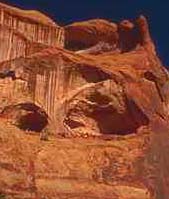 Everyone in California expects LA and San Francisco to some day be hit by the 'big one'. For many years seismologists have pontificated on plate movements, faults and the historical likelihood of a major quake. Many of these assumptions have now been challenged by research that has fundamentally rewritten the geological history of Californian earthquakes .
This new geological history of coastal California was developed using recent seismic studies and has major implications for earthquakes along the San Andreas fault north of San Francisco. According to Dr. Kevin Furlong, professor of geosciences at Penn State, "The model of the Mendocino Triple Junction -- the place where three tectonic plates in the Earth's crust come together -- as a slab window, is too simple to accurately portray events at the northern end of the San Andreas fault".
The Mendocino Triple Junction is the point where the Gorda, Pacific and North American plates meet. The Pacific plate moves north while the North American plate moves south. As these two plates pass by each other they cause earthquakes on the San Andreas fault and subsidiary faults. The Gorda plate also moves north, but at the same time it is also moving east, underneath the North American plate. Such a subduction of one plate underneath another created the Cascade mountains (including Mt St Helens and Mt Rainier). "At the point where the three plates come together, a complicated process that we dubbed the Mendocino crustal conveyer takes place," Furlong told conference participants at a meeting of the American Geophysical Union. Recent seismic studies have shown that the crust of the Mendocino Triple Junction is twice as thick as that north and south of the area. "We needed to determine if this thickening was caused by the mechanism at the triple junction or if it was simply an inherited attribute of the geology," says Furlong.
During their study researchers found that as the Gorda plate moves under the North American plate, a void forms at the intersection which allows hot magma to push up. The magma then hits the cooler edge of the North American plate, cools and then coagulates joining the North American and Pacific plates together. "As the Pacific plate moves north, it drags the North American plate with it. However, the North American plate was moving south and so the crust bunches up on itself and thickens," says Furlong.
Thickening and thinning of the crust alter the characteristics of the underlying rock, that then influences how the area responds during an earthquake.
"In the area where the plates stick together, the plates are essentially moving in the same direction. This explains why the area about 150 miles north of San Francisco has only minor earthquakes but never anything like the earthquakes that occur farther south on the San Andreas. If the two plates are not slipping past each other, there is no mechanism for a major earthquake, ", said Furlong. Furlong's research helps show more clearly the northern end of the San Andreas fault. His work also goes some way to explains the strange rivers of Northern California (where rivers flow north and south respectively, but between the raised areas, tend to meander and turn back on themselves).
So while Furlong's work may be little comfort to those in the bustling web city of San Francisco, perhaps it augurs well for a move north to the wine country of the Napa valley and beyond?