
3 December 1998
The Ultimate Peep Show
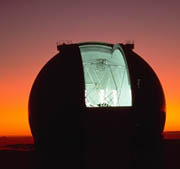 The whole world will soon have the stars and galaxies at its finger tips. The 0.9-meter telescope at Case Western Reserve University's Nassau Astronomical Station will go online by December 15 as the country's first Earth-bound robotic telescope accessible to the public. Amateur and professional astronomers alike can access the telescope by filing a viewing request through http://astrwww.cwru.edu/nassau/nassau.html
The first online astronomers will help CWRU debug and refine the telescope operations, says Earle Luck, professor and chair of CWRU's Department of Astronomy.
The robotic telescope will provide two ways of viewing images. The primary viewing mode will be deeper images taken with main observing instrumentation of the telescope. The other is a quick look through finder telescope. These quick images will be posted in real time to allow a browser to see where the telescope is pointed by the main observation request.
"You can put the telescope wherever you want in the observable sky as far as the software and hardware are concerned," he adds. The requests can range for viewing time from a fraction of a second to five minutes and can be a request for a simple image to images using colored filters in red, green, or blue.
Users also will need to provide the position of the object to be observed. This information is available through online astronomy catalogues, also linked to the site. As the site develops, Luck plans to add more user-friendly information to make it easier for all to access the telescope.