
17 November 1998
First Dinosaur Embryo Skin Discovered
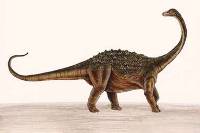 A team of researchers announced today in the journal Nature the discovery of a dinosaur nesting ground strewn with thousands of eggs, dozens of which still have unhatched dinosaur embryos inside. In addition to tiny embryonic bones, many of the eggs contain patches of delicate fossilized skin, providing the first glimpse of the soft tissue covering baby dinosaurs.
The extraordinary new fossils represent a number of scientific firsts: the first dinosaur embryos to show fossilized skin; the first known embryos of the giant plant-eating dinosaurs called sauropods; and the first dinosaur embryos found in the southern hemisphere.
The nesting site, which dates from the late Cretaceous and is approximately 70 to 90 million years old, is located near Auca Mahuida, in the Patagonian badlands of Argentina. The research team, headed by scientists from the American Museum of Natural History in New York City and the Museo Municipal Carmen Funes in Neuquén, Argentina, named the new site "Auca Mahuevo" for its tremendous abundance of eggs, or huevos in Spanish. Eggs are so plentiful in the square-mile nesting site that it is virtually impossible to walk without crushing egg shell fragments under foot.
If the tiny embryos from Auca Mahuevo had hatched, the baby dinosaurs would have started life a mere fifteen inches long and grown to an adult size approaching forty-five feet long. The fossil skin reveals a scaly surface, much like the skin of a modern-day lizard. One of the fossils has a distinct stripe of larger scales near its center, which probably ran down the animal's back.
Why Auca Mahuevo yields two of the rarest of all types of fossils, fragile embryonic bones and skin casts, is one of the mysteries about the site that the team hopes to answer. Initial studies suggest that the egg clusters were laid in the floodplain of ancient streams that periodically overflowed, burying the unhatched eggs on its banks in a layer of mud. The covering of silt protected the eggs, and some of their contents, from scavengers and disintegration by the elements. Repeated cycles of egg laying and flooding could have produced the super-abundance of fossil eggs and embryos found by the team.
Given the number of egg clusters at Auca Maheuvo, hundreds, if not thousands, of giant sauropod dinosaurs must have gathered there to lay their eggs. The nesting site probably would have stretched for miles in a valley created by a series of shallow streams. However, the fossils do not reveal whether the adult dinosaurs cared for their young, or even if they made well-formed nests. It is not possible to determine precisely which kind of sauropod dinosaurs laid the eggs at Auca Maheuvo, but the discovery of tiny teeth in the eggs provides an intriguing clue. One embryo alone has at least 32 individual pencil-shaped teeth, each small enough to fit easily into the capital "O" at the beginning of this sentence. The only sauropod dinosaurs alive at the end of the Cretaceous period with teeth this shape were sauropods known as titanosaurs. The remains of these dinosaurs are common near Auca Maheuvo, making it very likely that the embryos belong to this group.
Unlike any other known sauropods, titanosaurs had bony, armored plates embedded in their skin. The embryo's skin, however, does not show any signs of armored plates, indicating that these grew only after the dinosaurs had hatched. This growth pattern mirrors that seen in modern armored lizards and crocodiles, the juveniles of which lack the bony patches in the skin that are present in adults.