Home   |   News   |   Discussion Forum   |   Books   |   Curiosity Shop
Discussion Forum
Recent Posts
The platypus genome sequenced
redewenur
12:55 AM
Philosophy of Religions--all religions, including,
Anonymous
12:38 AM
edge of space; plausible
Mike Kremer
10:05 AM
Zealotry over Global Warming
ImranCan
07:07 AM
How Reliable are those climate models?????
Canuck
05/10/08 06:38 PM
Biofuels Starve the Poor
redewenur
05/10/08 08:00 AM
Artic Ice Free by 2013 !!
samwik
05/10/08 01:07 AM
Semantics, Etymology, Syntactics, Etc.
samwik
05/10/08 12:10 AM
Humanzee? Ape Human Cross
Ellis
05/09/08 11:43 PM
The Mystery of Global Warming's Missing Heat
Mike Kremer
05/09/08 04:12 PM
Hot Topics

The Environment

Evolution

Space

Mind/Brain

Electronics

Climate Change


Sponsored Links
Most Read
Hormones Gone Wild
Homo Superior
The Universe As Magic Roundabout
In Space, No One Can Hear You Say "Doh!"
Bow To Your Insect Overlords!
Bionics
Sex And The Schizoid Factor
Delusions And Mental Illness
We Come In Peace – NOT!
Eeew!
Small Penis Syndrome A Big Problem?
Have You Hugged Your Robot Today?
Down On The Farm - Yields, Nutrients And Soil Quality
Cat Parasite Has Global Ambitions
POP Goes The Planet
The Disappearing Male
Missing Link A Tripping Chimp?
Inorganic Dust Formations Alive?
Science Shopping
Sci Shop
Peculiar scientific stuff that you didn't even know existed and you don't need.
News And Research

Physics

Climate Change

Space

Natural World

Health

Technology


All 2008 News

Rusty's Reading List
Sci Books
Join Rusty Rockets for the lowdown on what you should be reading.
Search
Google

Science a GoGo Web
Archives
2008 2007
2006 2005 2004
2003 2002 2001
2000 1999 1998
Discussions
Features


6 July 1998
New Class Of Asteroid Discovered In Earth's Orbit
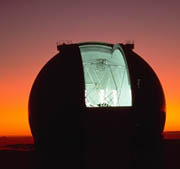
Just when we thought we'd reached Deep Impact saturation point, astronomers at the University of Hawaii have discovered yet another menace to life on Earth - a new type of asteroid whose orbits lie completely within that of our own.

"All other efforts to discover asteroids on a collision course with the Earth are being directed at a region of the sky almost opposite the Sun," says David Tholen, planetary astronomer at the Institute for Astronomy. "The significance of this discovery is that we would have otherwise never found this new asteroid because it apparently doesn't travel to that region of the sky being scanned by other search efforts."

Tholen and graduate student Robert Whitely made the observation from the University of Hawaii's 2.24 metre telescope atop Mauna Kea last February. Scanning the dusk and dawn skies, they came across an asteroid thought to be 40 metres in diameter - similar in size to the one that devastated the Tunguska region of Siberia on June 30, 1908, as well as the iron object that produced Meteor Crater in Arizona 50 000 years ago.

Designated DK36, the asteroid is likely to pass a safe 750 000 miles from the Earth's orbit. "1998 DK36 is nothing to lose sleep over," says Tholen. "It's the ones we haven't found yet that are of concern."


BACK

Home   |   News   |   Discussion Forum   |   Books   |   Curiosity Shop   |   About
The terms and conditions governing your use of this website.
Copyright © 1997 - 2008 Science a Go Go and its licensors. All rights reserved.